Possible tax targets Illinois smokers
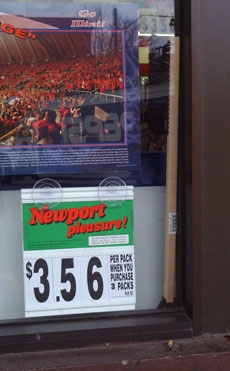
Online Poster
Mar 10, 2005
Last updated on May 11, 2016 at 07:38 p.m.
By Kalyn Cooper
Staff writer
Gov. Rod Blagojevich has proposed a tax increase on cigarettes and other tobacco products.
If passed, the bill would increase the price of cigarettes by 75 cents and cigars by an undetermined amount, according to a Feb. 16 press release. This would raise the tax from 98 cents to $1.73 per pack. This increase would generate more than $150 million each year in new revenue to be used to pay debt and provide health care to 74,000 people, the press release stated.
Get The Daily Illini in your inbox!
The bill would affect many student smokers and the market for cigarettes would be hurt, said Sam Smith, an employee at Colonial Pantry, 312 E. Green St.
“Seventy-five cents a day might not be enough to make students quit smoking, but it would keep new people from starting,” Smith said. “A lot of our business is people who come in to buy cigarettes on the weekends after they’ve been out drinking.”
Brett Hapeman, junior in LAS and head of corporate relations for Colleges Against Cancer, agreed that a tax hike would cut smoking rates among students.
“If the government keeps increasing taxes, students will have to stop smoking for monetary reasons,” Hapeman said. “College kids are poor anyway.”
Smith, a University alumnus, said he smokes a pack of cigarettes a day, and the price increase most likely wouldn’t affect his habits.
“You don’t notice the price going up because they raise it 75 cents here and 30 cents there over a long period of time,” Smith said. “If they designated a definite five-dollar tax at one time, it would be a big difference.”
Eve Winiarski, sophomore in LAS and advocacy co-chair for Colleges Against Cancer, said she supports Blagojevich’s proposal and wishes more would be done to combat student smoking.
“This may bring smoking down a little, but smoking is addictive,” Winiarski said. “It won’t help people who already smoke. The tax revenue from this could be used for drug education or help prevent tobacco-related diseases.”
Winiarski is also trying to promote a bill that would put tobacco products under the control of the Food and Drug Administration (FDA).
“Kraft and Phillip Morris are owned by the same company, so shouldn’t they be regulated by the same people?” she asked. “It seems silly to me that the FDA is checking macaroni and cheese but not cigarettes.”
Winiarski said Collegians Against Cancer is also working on petitions to further awareness and support of the issue.
Smith said Colonial Pantry sells about 95 packs of cigarettes on an average day and more on weekends. Winiarski said Champaign County has one of the lowest smoking rates in the nation, but those numbers increase rapidly on campus every weekend.
The increase of cigarette sales on weekends likely is connected to social smoking and the hazy atmosphere of campus bars, Hapeman said.
“There’s smoking in every bar on campus, so students don’t have the option of going to a bar with clean air,” he said. “You can barely breathe sometimes, and when you come home your clothes smell like smoke for weeks.”
For these reasons, Hapeman and other students in Collegians Against Cancer sponsored a smoke-free bar crawl on Monday night, their second one to date.
Group members went to C.O. Daniel’s and The Clybourne, which were smoke-free for that night after the group reached an agreement with owner Scott Cochrane.
“Students are really enthusiastic about the smoke-free atmosphere,” Hapeman said. “Usually bars are so smoky that if you’re in there long enough, it’s just like smoking three or four cigarettes. If you go out three times a week, you’re a smoker.”
Cochrane said he wants to help advertise future smoke-free bar crawls because he really likes the idea, Hapeman said.
Winiarski said that people don’t realize non-smoking bars are a possibility because students have learned to live with the environment.
“Smoking is illegal in bars and restaurants all over New York and California,” Winiarski said. “That should really set the precedence for health all over the country, and I think it’s a possibility for Chicago in the next few years.”
Skokie, Ill., and Wilmette, Ill., suburbs of Chicago, have already banned smoking in public places.
For now, cigarette retailers like Colonial Pantry are benefiting because smoking is allowed on campus. Smith said prohibiting smoking in public places would hurt business much more than Blagojevich’s tax proposal could.
“The smoke doesn’t bother me, but I guess I’m used to it,” Smith said. “(Cigarettes) are out there, and it’s really an endless cycle. There’s no easy solution.”