The Division of Parks and Natural Spaces, formed earlier this year, is working to address maintenance needs and create a more connected and accessible Arboretum.
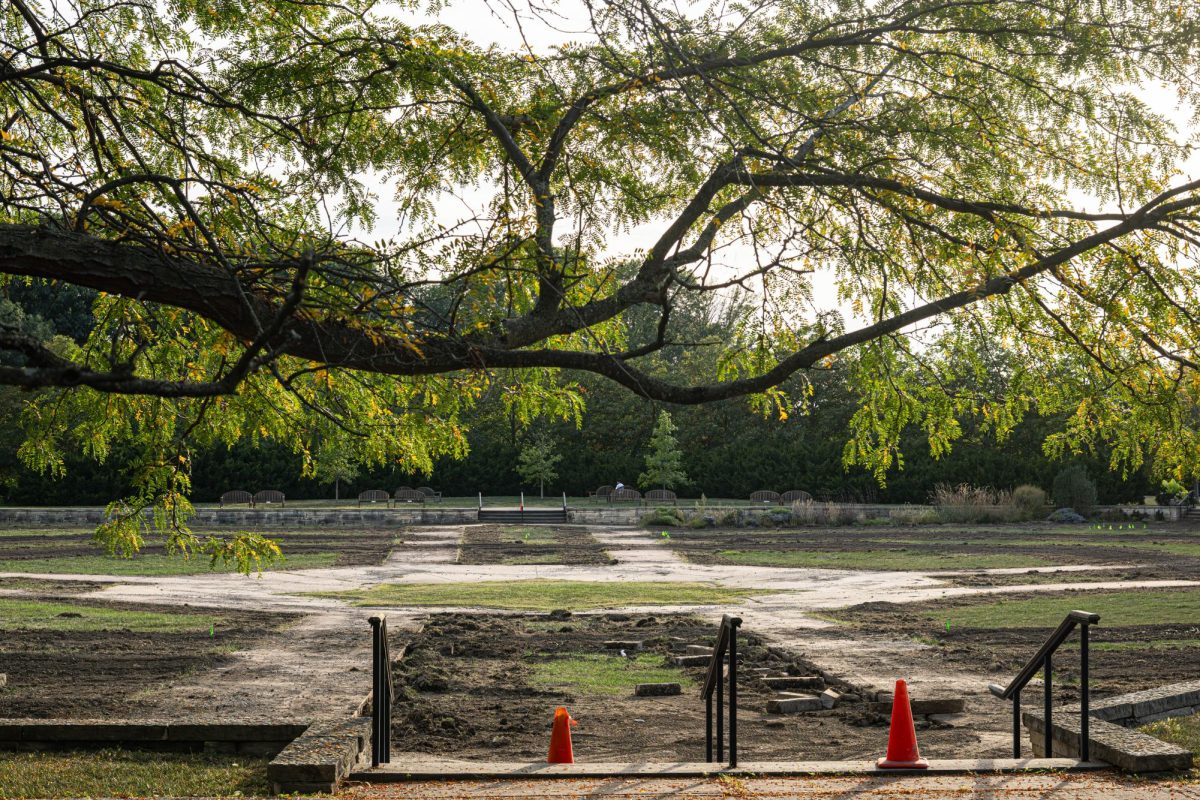
Immediate efforts like invasive tree removal and turf installation are creating a “blank slate” for future development. Longer-term plans include the addition of pathways, new turf grass and multi-species “tree museums,” according to a press release.
However, DPNS leaders emphasize that the true focus of the restoration is fostering a connection between the Arboretum and campus, as well as improving accessibility.
“The Arboretum is disconnected,” said Derek Peterson, executive director of the DPNS. “It feels physically and somewhat spiritually disconnected from campus. I’m always surprised how, especially students that I talk to, talk about how far away it is from campus. To me, it’s right in the middle.”
Some efforts to improve connectivity at the Arboretum are already underway. A former “desire path” — a dirt trail created by foot traffic between the Dr. Frank W. Kari Walkway and the Ponds — has been paved for accessibility.
Get The Daily Illini in your inbox!
According to a 2021 master plan created by the College of Agricultural, Consumer, and Environmental Sciences before the formation of the DPNS, more of these informal routes are to be converted to permanent walkways. This includes one linking the Idea Garden to the Arboretum parking lot — a much-needed change, according to the Idea Garden’s Master Gardeners.
“Some people can’t make it very much further than the Idea Garden,” said Ryan Pankau, horticulture educator for Illinois Extension, who oversees the Master Gardener Program across four different counties. “I would love to see some of these paths that connect things and just kind of move folks around the Arboretum in a more meaningful way.”
In addition to adding physical pathways, DPNS has begun to connect with the community by expanding public programming.
The Farms: An Allerton Folk School, which also falls under the DPNS umbrella, offers tree identification walks and migratory bird hikes on Arboretum grounds. Staff say the programs provide students and community members more opportunities to use the Arboretum as an educational resource.
Peterson said the division is emphasizing student academics while also aiming to broaden understanding of trees and landscapes. That includes replacing invasive species with native trees and expanding community programming, which he believes there is a strong appetite for among students and the wider Champaign-Urbana community.
Despite this appetite for programming, some students say they are relatively unaware of activities held at the Arboretum and that promotional materials don’t always reach the student body.
Charlie Boe, freshman in FAA, discussed how he only knew about the Arboretum because of a class assignment.
“I honestly wouldn’t have too much of an idea that (the Arboretum) exists, which is a shame, because I feel like it’s pretty extraordinary,” Boe said. “It was just kind of this nice little paradise, just away from all the worry, even the stress … that comes in college.”
The Arboretum’s development will be gradual, according to Peterson.
While some paths and gardens have been updated, most connections are expected to take several years to complete. The 2021 master plan, created by ACES before the formation of the DPNS, guides many of the restoration priorities.
Although features such as multiple pavilions and an amphitheater were included in the original 2021 master plan, they are not part of the current restoration. Instead, DPNS officials say the focus remains on maintaining a well-connected, accessible and properly maintained arboretum.
“Green space in general is getting harder and harder to come by,” Peterson said. “We need that green space to connect, both environmentally and to each other.”