It’s Lachia Bennett’s first time at Windsor Road Christian Church’s Free Food Store— she needs a little help through Thanksgiving. Another patron, Paige, has only started coming in, though her mother, a University employee, has been shopping here longer. As for Caroline, a graduate degree holder, it’s her second time here after a difficult year of unemployment.
Everyone waits in a large hall of tables and booths before they can go shopping. Two young boys sit in perfect silence in identical positions — elbows on the table as they hold up books at their noses, their eyes just peeking out over the pages. Their mother sits in between them.
“You boys are doing pretty good; I couldn’t sit still that long!” says an older man volunteering. The boys look up briefly and smile before returning to their stories.
Bennett says the free food store is a relaxing, comfortable space.
“Nice and open … not too close,” she says, surveying the hall.
Get The Daily Illini in your inbox!
But that was a sleepy Thursday evening, Nov. 6. The weekend before, Supplemental Nutritional Assistance Program benefits lapsed for the first time in history. And on that day, for the first time in their own history, WRCC’s Free Food Store had to turn people away.
“100 families in 35 minutes,” Michelle Santiago, outreach ministry director at WRCC, says, referring to the number of people served on that Saturday. The church, Santiago adds, has never seen a number like that before.
According to Rep. Nikki Budzinski, D-Ill., who was interviewed by The Daily Illini earlier this month, about 17% of Illinois’ 13th congressional district is on SNAP, higher than the national rate of 12.3% of Americans who are enrolled in the program.
Santiago shared with The DI that in October alone, the free food store, open every Thursday evening and the first Saturday of each month, served 901 people, compared to 646 last January.
Although the Free Food Store was not bustling like it was during the weekend, every table was taken up on Nov. 6, whether that be by multi-generational families or older men and women who came alone but eventually started sharing a table and conversation.
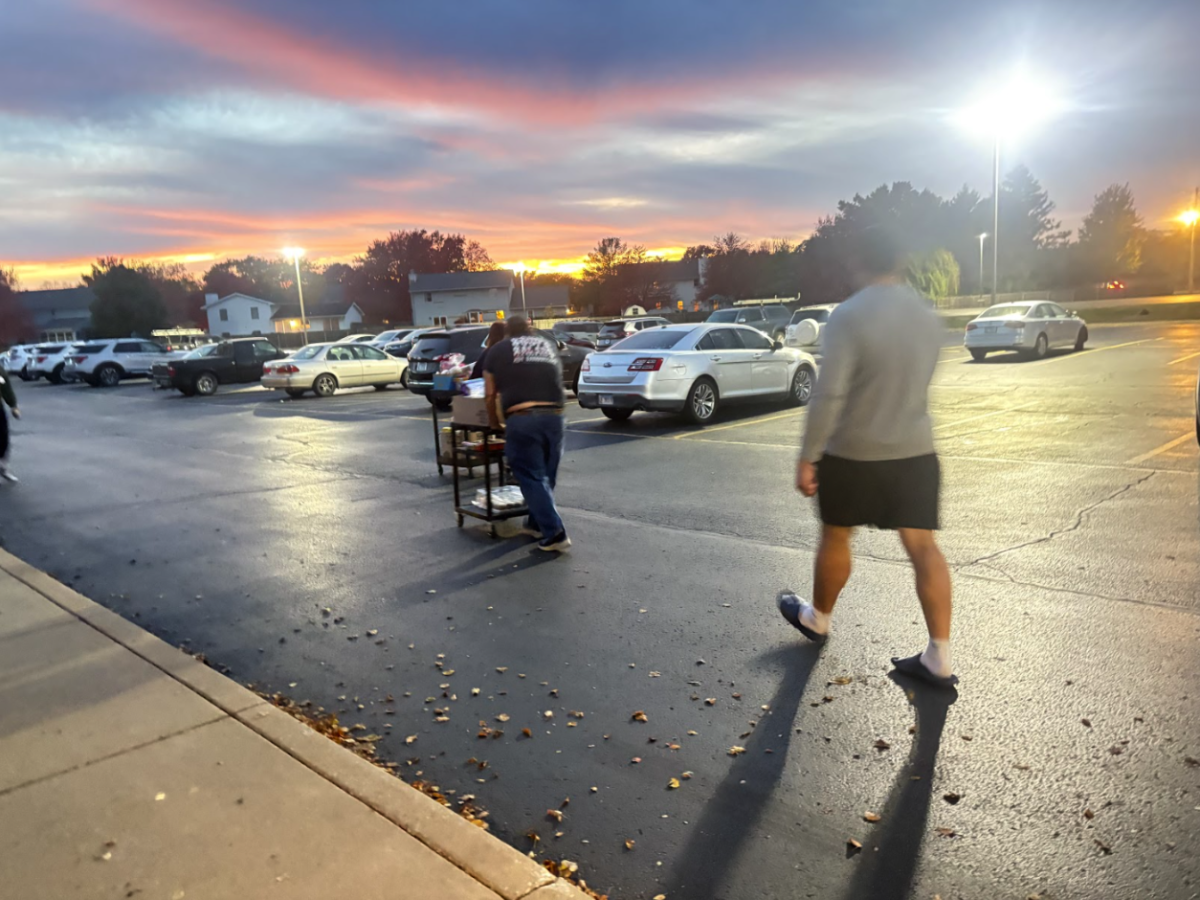
The sound of the room is a calm murmur, never rising much. Volunteers, including a burly Illini football player, shuffle in and out of the building, carting boxes of food from the smooth carpet onto the concrete outside, where car trunks are waiting to be filled.
While SNAP assistance is back with the end of the government shutdown (though former recipients may have to reapply), patrons interviewed told The DI how much of an issue food and economic insecurity has been for them of late.
Misty, a congregation member, says that she and her companion have been feeling squeezed.
“We are on a limit,” Misty says. “I’m on disability, so for a while we’ve been struggling because our income is just not where it needs to be.”
An adventurous home cook who is applying to the University in the near future, Misty appreciates the personability of WRCC — part of a philosophy that focuses not just on the food that is distributed, but how it is distributed.
“How” it’s done is with a, “Hello! How is it going?” from friendly volunteers who zip between tables, dip into conversation and provide books and snacks bundled neatly in Ziploc bags.
Above all, though, there’s an emphasis on maximum choice and comfort. In the back of the store where the food is kept, there are piles of fresh produce and cans of soup and vegetables and stocked refrigerators and mounds of prepackaged bread. Shelves are purposefully never left bare so as to not induce the anxiety that scarcity brings — known all too well by many here.
But Santiago says the non-denominational church’s food services are “beyond capacity of business” with recent demand.
In certain instances, food is going “to-go” style in large brown paper bags — which previously hadn’t been done due to being at odds with the highly personal and purposefully unrushed philosophy of the pantry.
But Santiago says the pre-prepared grocery packages in them are still thoughtfully made to give recipients a well-rounded supply. She gave The DI a peek into a brown paper bag packed near to the brim with foodstuff.
Caroline, a patron, sits alone at a booth with a book. In Spanish, she tells The DI of how she was laid off from her remote job in December after the company she worked at fired thousands of workers. She hasn’t been able to find a job since, not for want of trying very hard, and despite a graduate degree she says she holds.
“I did a doctorate and it turned out very well,” Caroline said. “And now the situation I find myself in is completely desperate.”
Everything, she adds, is too expensive, indicative to her of a downturn in the greater national economy.
According to the Bureau of Labor Statistics, the Consumer Price Index, or CPI, a measure of the average price of consumer goods, has been largely rising the past year, with prices for food increasing by 3% since last year.
Both local and national energy prices, another concern for households, have also been spiking, increasing in the Champaign-Urbana area by around 20% in the summer — related to a larger trend of energy bills outpacing the rate of inflation nationally.
Caroline has applied to both jobs in the field she studied and supermarket jobs that would make little use of the skills she learned in school. She has lost homes and is dealing with the burden of a low credit score and high grocery costs.
“When we’re at the top we think we’re very powerful, but really God is the one in control,” Caroline said.
Although Caroline is going through difficult times, she still believes everything, including this struggle, has a purpose: “to value more things that we sometimes thought were commonplace.”
Other people are going into the next room to shop after their number is called, and the murmur of pleasantry and conversation begins to die down as the room thins out.
Caroline, hands folded, her book flat in front of her, waits for her turn.
To contribute to Free Food Store services, prospective donors can visit this link or write a check to the church.
Windsor Road is also looking for 36 business partnerships to help cover the costs of the store for 2026.