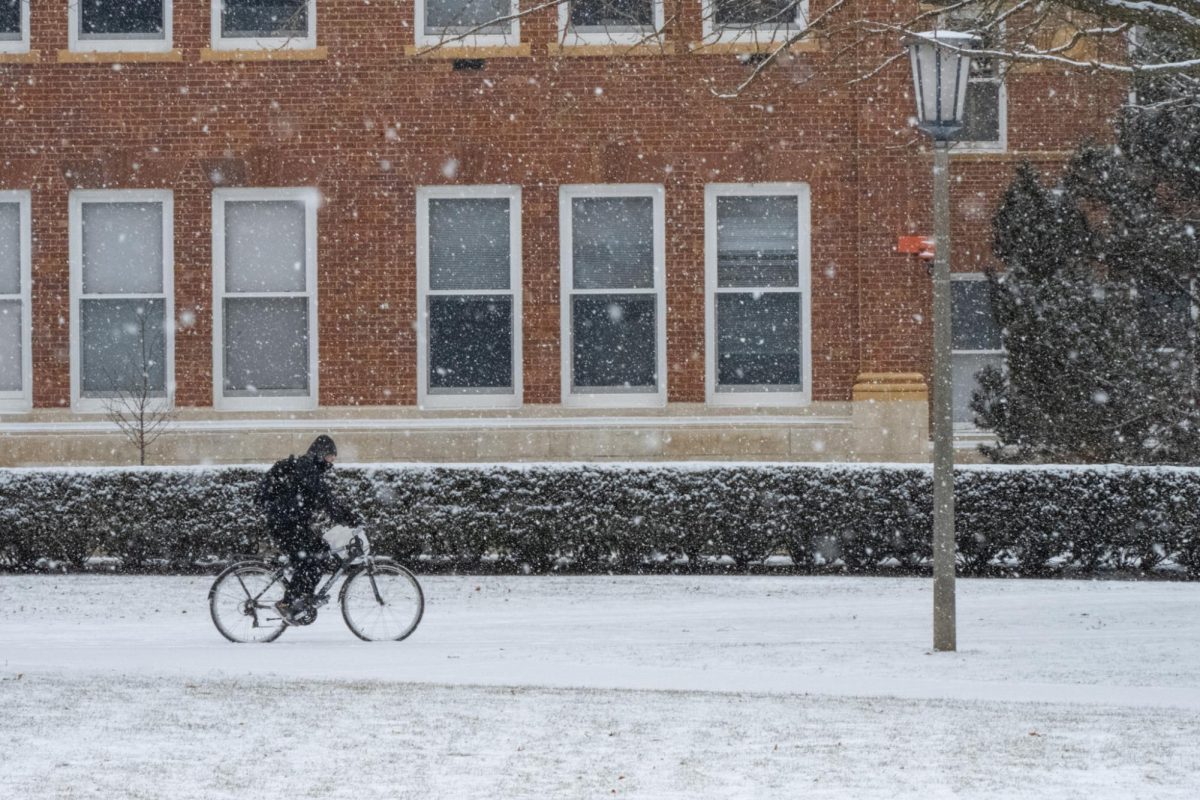
Champaign-Urbana may be in for a colder, wetter winter this year due to a La Niña weather event.
A La Niña event is marked by a cooling of the Pacific Ocean near the equator and occurs roughly every two to seven years. The pattern contrasts with the El Niño pattern, which can create warmer, drier winters in Illinois.
Jeff Frame, professor in LAS, spoke with The Daily Illini about the upcoming winter.
Frame said this year’s La Niña may be weaker than normal, which would make room for other weather patterns to influence temperatures.
“There is a large warm anomaly in a lot of North Pacific right now,” Frame said. “It’s possible that that brings a big ridge up over Alaska, and then you’ll have a downstream trough, which is cold air somewhere over North America. But would that set up west of here? Would that happen at all? … We don’t know.”
Get The Daily Illini in your inbox!
For Miguel Lorenzo, sophomore in Information Sciences, Illinois winters are a far cry from those of his home country, Panama. Due to its proximity to the equator, Panama’s temperatures linger around 80 degrees Fahrenheit year-round.
Lorenzo said many aspects of his first winter at the University were jarring, such as how early the sun set and how many layers he had to wear in minus 4 degrees Fahrenheit weather.
“You need to really prepare how you’re going to go out – you need a puffer, you need pants, if it snows you can’t wear nice shoes because it can get wet,” Lorenzo said. “There are all these things you’re not prepared for as an international (student).”
Sanvi Grover, junior exchange student in LAS, will be getting her first taste of cold weather this season during her first and only semester at the University. Originally from Sydney, Australia, Grover is looking forward to experiencing an Illinois winter.
“I’m really excited for it,” Grover said. “The other day when the snow fell, that was my first time seeing snow fall, ever, from the sky. I’ve seen snow before, but never (falling) from the sky.”
Grover said that temperatures in Sydney rarely fall below 40 degrees Fahrenheit, even in the coldest months.
“I’ve heard that Illinois is really windy, so I was a little nervous for that because Sydney is not a very windy place,” Grover said. “Even with all my clothes and stuff, I was feeling a little underprepared.”
According to the National Weather Service Climate Prediction Center, there is a 40-50% chance that C-U will experience a wetter-than-normal season, though temperatures will influence what kind of precipitation falls.
“Would that be rain?” Frame said. “Would that be snow? We can’t say.”
Frame explained that although there are predictions for a colder, wetter winter season, it is difficult to accurately forecast weather this far out from the heart of winter.
“(For) day-to-day weather, we cannot predict beyond about seven days,” Frame said.
University students — both Illinois natives and international newcomers — will have to wait and see what kind of winter this year has in store for them.
“I want to say that I’m excited for this experience, but I don’t think I really am,” Lorenzo said.