Last updated on March 4, 2026 at 01:35 p.m.
Working as a post-secondary counselor at Adlai E. Stevenson High School in Lincolnshire, Illinois, Sara Hanson advises juniors and seniors on the college application process. Out of the nearly 1,200 recent graduates from Stevenson — the eighth-ranked public high school in Illinois — 186 students now attend the University. Even so, expectations about which students get accepted vary, she said.
The University releases regular decision results March 6.
The University’s acceptance rate has significantly decreased in recent years, going from 63.3% in 2020 to 36.6% in 2025, with the Gies College of Business, The Grainger College of Engineering and other colleges being more selective.
“Parents of applicants are surprised to hear about the University’s increased selectivity, often basing their assumptions on when they were applying to college”, said Hanson. While a certain type of student used to get in based on their academics, she said, that is not always the case now.
Get The Daily Illini in your inbox!
“In the past few years, we’ve seen that the academics can vary a little (between students),” Hanson said. “It’s becoming more about the fit and more about the essays.”
The University’s Office of Undergraduate Admissions uses a whole-context holistic review to determine whether to admit an applicant, looking at their academic performance and test scores but also contextual factors to see what impacts their accomplishments. These include what opportunities existed at their high school and their family background.
Hanson said many Illinois families count on their children receiving acceptance to the University, considering that it is the state’s flagship school. In-state tuition at the University is also more affordable than out-of-state tuition and private tuition at other Big Ten colleges.
The Daily Illini spoke with Lorenzo Baber, professor in Education and former mid-level administrator in Undergraduate Admissions. The Daily Illini also examined admissions data from the past five cycles to get a clearer picture of the University’s admissions process.
Selectivity by residency
As a land-grant institution, the University has the mission to serve the people of the state of Illinois, according to Baber. This causes in-state students to make up a large portion of the undergraduate population, most recently accounting for 71.54% of freshmen enrollment.
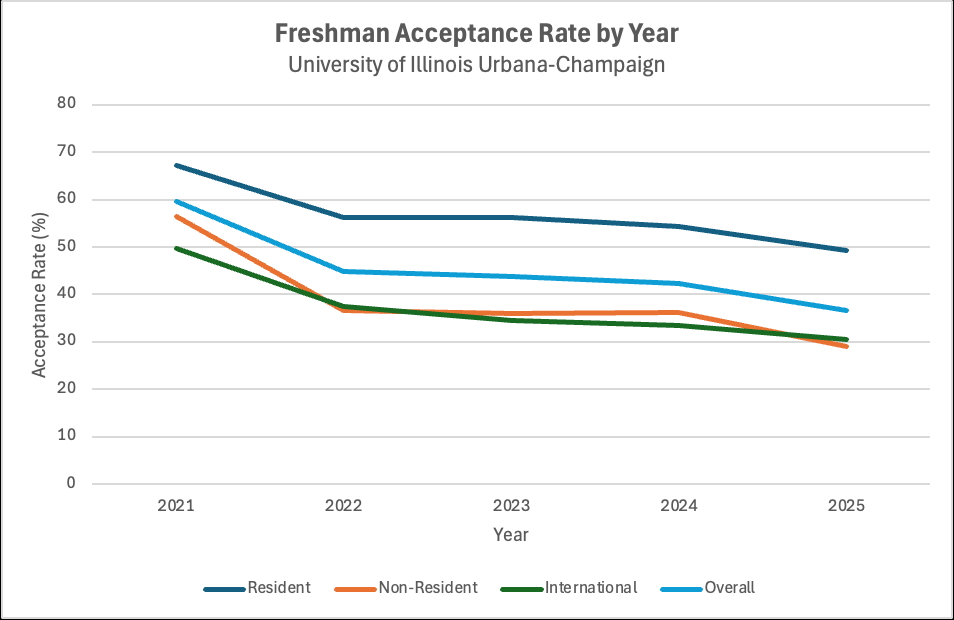
Illinois residents are accepted at higher rates than out-of-state and international applicants. This pattern has been seen since at least the 2020-2021 admissions cycle, with residency-specific data unavailable before then.
In the 2024-2025 admissions cycle, while the overall acceptance rate was 36.6%, Illinois residents were accepted at a much higher rate of 49.3%. Out-of-state and international applicants were admitted at lower rates of 29% and 30.5%, respectively.
Baber said alongside the University’s land-grant status, it must balance enrollment management priorities with its research status.
As an R1 research university, with $755 million in research expenditures in fiscal year 2024, the University attracts talent from across the world. The R1 designation comes from the Carnegie Classification of Institutions of Higher Education, meaning the University is very high in research spending and doctorate production compared to other universities and colleges.
Birth rates, target class sizes
Baber said when universities and colleges determine target class sizes, they look at birth rates to predict the number of high school graduates.
Actual freshman enrollment has exceeded target numbers in recent years. Sara MacKenzie, executive director of Undergraduate Admissions, told the University Senate Committee on Admissions that for Fall 2024, the University aimed to have 8,250 to 8,450 new students. The following year, they hoped to have 8,700 to 9,000. In both cases, freshman enrollment exceeded 9,000 students.
The University is planning to have a Fall 2026 class size slightly smaller than the Fall 2025 class, wrote Daniel Mann, associate provost for enrollment management, in an email to The Daily Illini.
The number of applicants is expected to start decreasing across the United States, as the birth rate has been declining since the Great Recession in 2007.
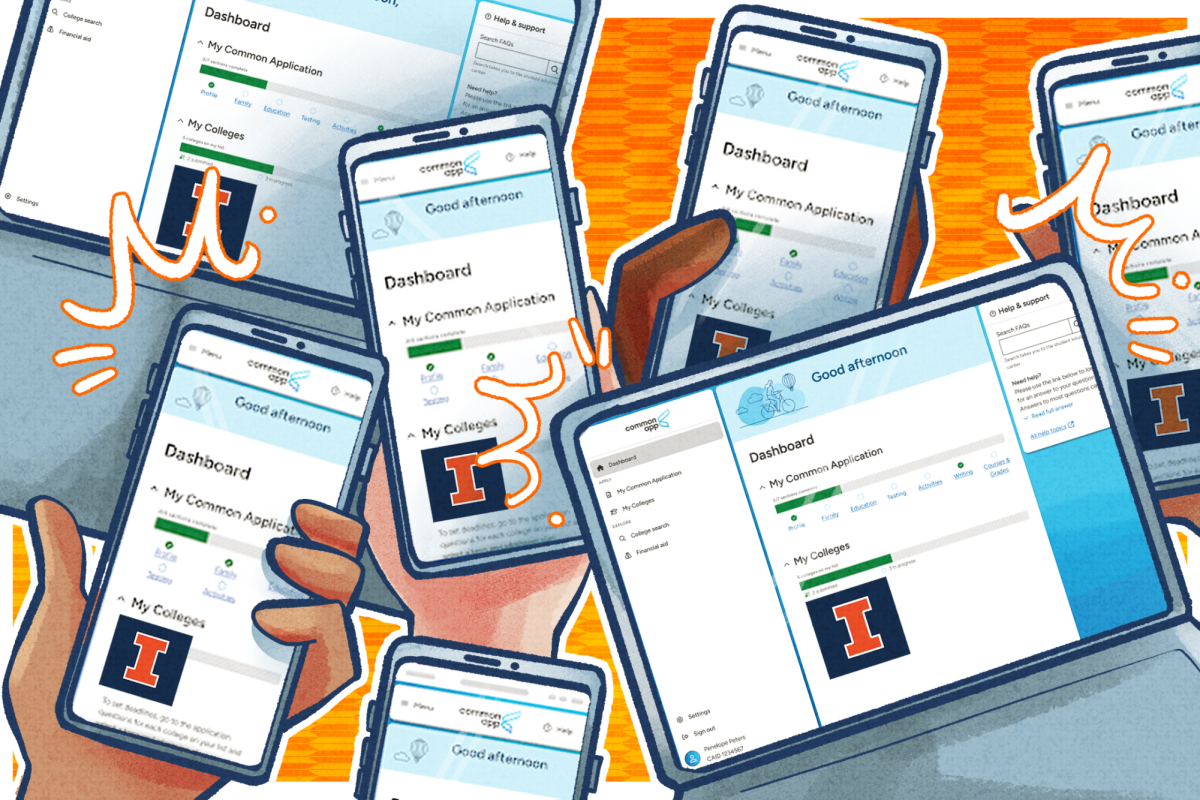
In the 2025-2026 admissions cycle, first-year applications to the University increased by 2%, wrote Mann. This is less growth than in previous admissions cycles. Submitted applications increased by 12.62%, from 73,742 applicants in 2024 to 83,045 in 2025.
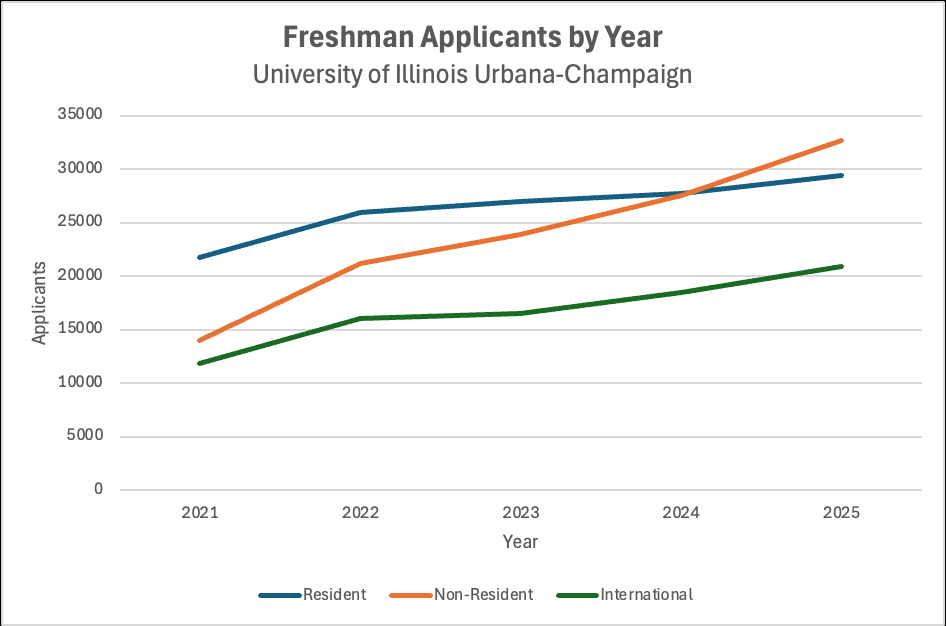
The number of applications from Illinois residents for Fall 2026 remain similar to Fall 2025, while the number of out-of-state applicants went slightly up and the number of international applicants went slightly down.
Since the University receives more applicants than it admits, Baber said, it may not be very sensitive to the expected decline overall, but specific colleges, such as the College of Education, might be. This means the University may need to look at how to attract other students who want to be teachers or work in education-related fields, such as engaging in outreach to potential transfer students, according to Baber.
Institutional reputation
The University is seen as the most prestigious and popular public institution in the state, Baber said, with not many public competitors. The private competitors include Northwestern University and the University of Chicago.
This is a unique challenge that the state of Illinois faces, according to Baber. He said that other states have more than just one institution deemed popular. In Michigan, there is Michigan State University and University of Michigan, and Indiana has both Indiana University and Purdue University.
The University of Illinois Chicago, Baber said, has increased in reputation and status over the years.
“Sometimes (the University) is viewed disproportionately as ‘the place’ rather than one of many places (of higher education in the state),” Baber said.