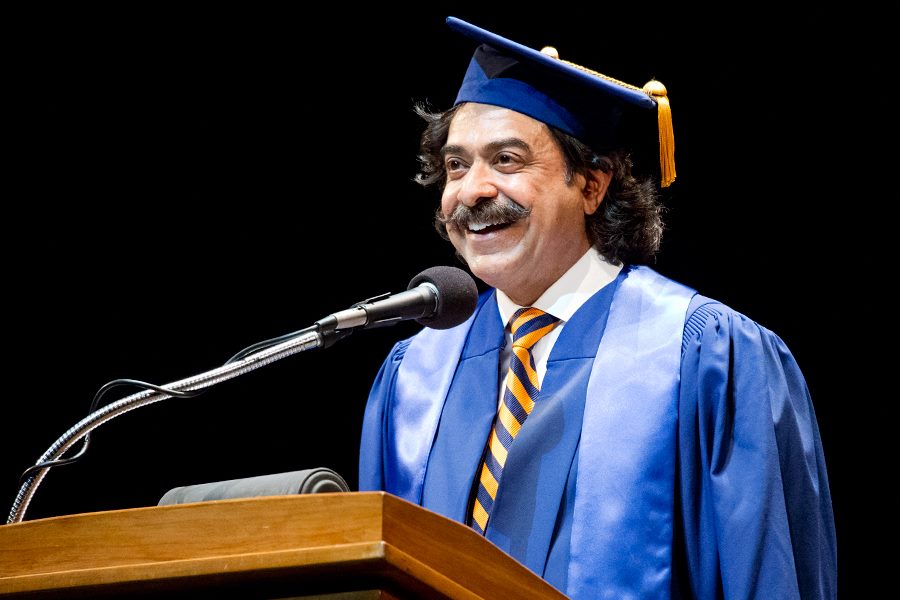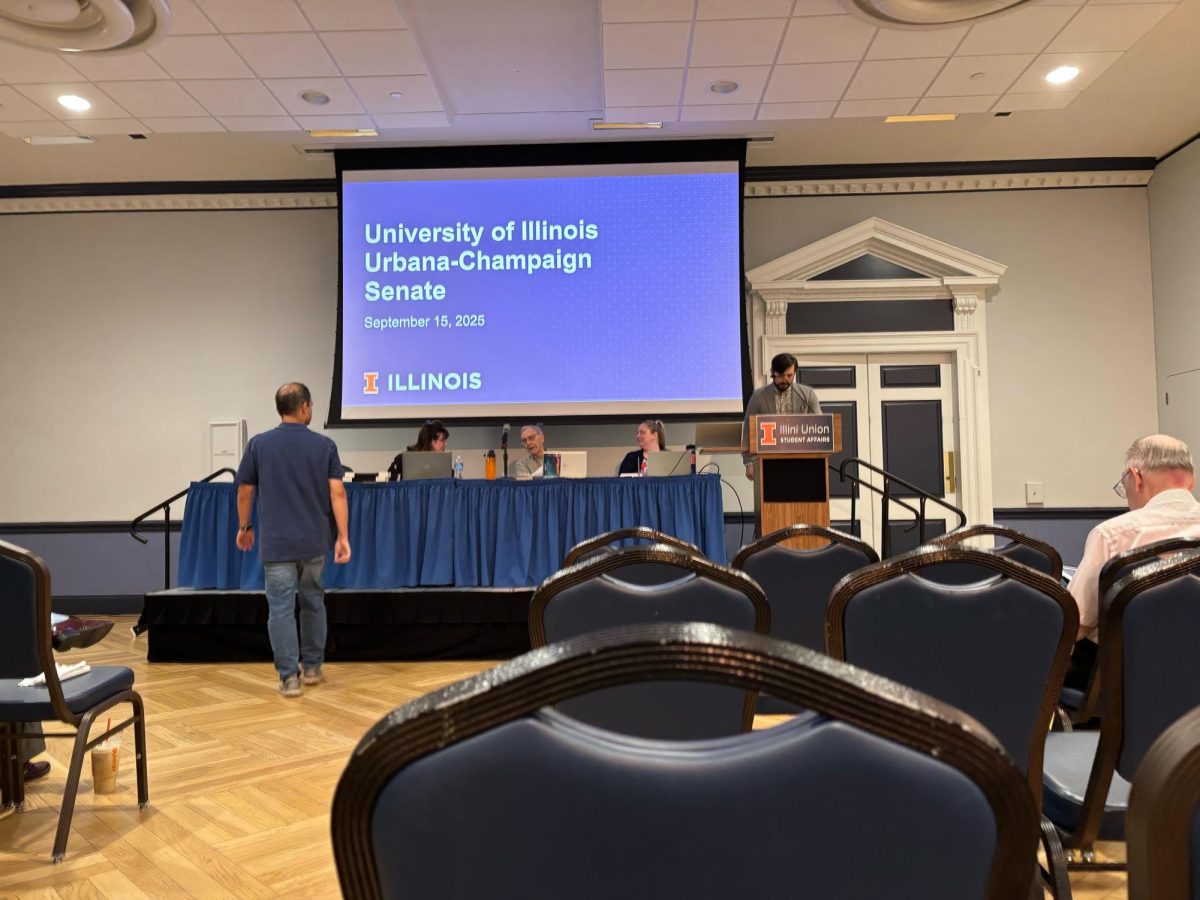
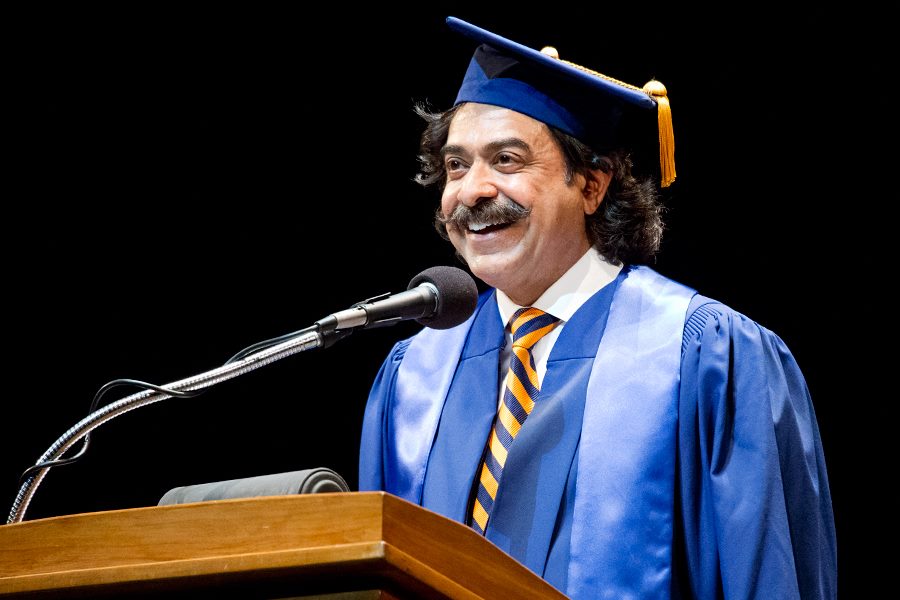
The University Senate voted against the proposal for establishing an ad hoc committee for honorary degree awards in a vote tallied 48 in favor and 95 against on Sept. 15. The decision comes less than a year after Shahid Khan, University alum and billionaire, was publicly and controversially denied an honorary degree.
The proposed special-purpose committee is one of a series of honorary degree process changes since Khan’s December rejection. In the months following the incident, the University began looking into making the process private — a challenge due to rules surrounding the Illinois Open Meetings Act. In March, former Chancellor Robert Jones paused the awarding of new honorary degrees altogether.
To begin the September Senate meeting, Angela Lyons, Senate executive committee chair and professor in ACES, gave opening remarks to the floor justifying the need to create the new committee.
“It makes sense as an ideal moment for us to reflect on priority areas, and one of those is honorary degrees,” Lyons said. “These individuals do not ask to be nominated — we make that choice — and it’s reasonable to want to have a process that’s sensitive to protecting the privacy of those individuals (whom) we are nominating.”
If approved, the committee would have been in charge of reviewing the current honorary degree process and informing the SEC of potential improvements. It would have been a separate body from the already-existing honorary degrees committee, which approves candidate recommendations and presents them to the rest of the Senate for voting.
Get The Daily Illini in your inbox!
Lyons also said the OMA makes it difficult for the nomination process to be made private, and the committee would be tasked with building privacy into the process.
“But we are operating under a serious constraint — OMA — and we need to create a more private pathway for us to do this that does not violate OMA,” Lyons said.
Camille Cobb, professor in Engineering, began senator discussions by asking Lyons why the creation of a new committee was necessary.
“In your opening remarks, you correctly anticipated that a lot of us would have questions,” Cobb said. “Why is this being directed to a new ad hoc committee instead of the existing honorary degrees committee?”
Cobb continued by recalling Flex-N-Gate’s unethical labor practices and proceeded to dispute Lyons’ recollection of Khan’s December honorary degree denial.
“And then we did self-governance, and we voted that (Khan) shouldn’t receive an honorary degree,” Cobb said. “So I wouldn’t call that a mishap. I’m confused about your characterization of it as such. So in my view, that was actually a prime example of academic freedom and self-governance.”
Lyons responded to Cobb, saying she doesn’t want the current honorary degrees committee split between focusing on the nomination process and the candidates themselves, and the new committee would have representatives from a broad range of backgrounds.
Jon Hale, professor in Education and former SEC chair, voiced concern over comments made by University administrators to local press. After Khan’s December honorary degree rejection, University of Illinois Board of Trustees Chair Don Edwards told The News-Gazette that “Khan’s faculty critics ignored their own rules in denying the honorary degree,” and he requested an examination of University Statutes.
“(The Board of Trustees) seemed to be directing the Senate on how to act because they weren’t happy with how this Senate voted,” Hale said. “And the Senate was following statutes — they did nothing wrong. Nothing was actually directed to (the) SEC or the Senate, it was only in the paper.”
“I’m concerned that if we do this for the board now, and we surveil ourselves and police ourselves when the board is upset with us, what are we gonna do when bigger issues come up this year?” Hale said.
Hale, similarly to Cobb, questioned the necessity of a new committee.
“If we’re honoring the labor of senators, why are we creating an ad hoc committee and asking people to do more work when we have an HD committee in place to do that work that we’re asking of them today?”
David Forsyth, professor in Engineering and academic freedom and tenure committee chair, added information regarding the University Statutes.
“If you read the statutes, the Senate is required to offer candidates for honorary degrees,” Forsyth said. “The statutes read ‘the Senate shall,’ and no other body has the power to do so … However, we are not required to adopt a process that maximizes embarrassment in proceeding to determine who our candidates are.”
The next SEC meeting is Oct. 6, and the next Senate meeting is Oct. 13.