The University’s student elections are right around the corner. Voting begins for the 2025-2026 Illinois Student Council on Feb. 17 at noon and ends at 11:59 p.m. on Feb. 19.
The Daily Illini spoke to members of the ISC who serve in various positions to detail the roles, responsibilities and functions of the body.
An introduction to the ISC
The ISC is a council that represents the student body and advocates for the betterment of all aspects of campus community and life.
“The mission of ISC is to advocate for the better of the campus community and to put on programming that directly helps the student body and hears the student body and best addresses their needs,” said Ethan Lopez, a junior in LAS and a representative for the college.
Get The Daily Illini in your inbox!
The ISC is separated into two main branches: executive and legislative. The two branches are supported by advertising and support teams. The ISC also has various committees within it. Each branch and committee has its own roles and responsibilities.
The executive branch, broken up into administrative officers, coordinators and liaisons, focuses on “operational aspects, promotes initiative” and is a spokesperson for ISC, according to the ISC website. Additionally, the executive branch fosters relationships with the University administration and outside parties. It includes the president and vice president positions.
The legislative branch focuses on advocating and deliberating developing solutions to student worries and desires, consisting of legislative officers, committee chairpersons and student representatives.
Each committee has a chairperson and six student representatives, including one who serves as the vice chairperson. The committees also include two at-large members; executive committees have two ex-offico non-voting members.
Another role of the ISC is to create new programs and initiatives on campus. In the past, ISC has created the iClicker Loan Program, Cozy Thrifts and more.
“(ISC has) done a lot of great things for students,” Lopez said. “We have lots of initiatives that come directly from ISC that help students. We have Cozy Thrifts, which we started doing annually, where we provide winter gear to students who need it.”
Alongside the candidates, there are also several referendums on the student election ballots. A referendum is a direct, non-binding vote on a specific policy, issue or question. According to Lopez, the University uses the data as a factor in policy and decision-making.
This election, there will be 13 referendum questions. The questions include gauging student perception on possible increased fees, like supporting cleaner campus energy, campus expressive policies and divestment from fossil fuel companies.
“Once referendums pass — which they usually do — the University sees this and they put that into consideration,” Lopez said. “But it’s important to know that these referendums are non-binding … it’s more of a gauge of student opinion and certain voices related to certain matters.”
The Student Election Board — which the University created to replace the former Campus Student Election Commission — runs the elections, organizes the candidates and seeks a smooth election. The SEB is hosting town halls for the president, vice president and student trustee candidates on Tuesday and Wednesday.
There are two weeks of campaigning — which are ongoing — when candidates seek endorsements by various registered student organizations and create a strong social media presence until the polls open.
After elections occur and the SEB announces the winner, the transition between administrations typically occurs the first or second week of April.
“The amount of good work we can do to provide for students and advocate on the administration level, it really is important to have good advocates and be aware of the kinds of people who advocate for you,” Lopez said. “But when the time comes it’s important that you know you have an advocate in your corner at ISC, and ISC serving as that advocate body is so important.”
The work of the legislative branch
Hunter Farnham, ISC Speaker and senior in LAS, leads the legislative branch of the ISC. The branch works to pass legislation outlining internal processes and coordinating various initiatives.
While separate from the executive, the two branches work together. In many ways, the branches operate similarly to those of the United States government, according to Farnham.
The ISC representatives connect with students, listen to their concerns and research campus issues like accessibility and food insecurity, Farnham said. Then, they translate that information into legislation. From there, the executive branch chooses to act on the legislation.
“In an ideal world, we’re collaborating every step of the way,” Farnham said.
Much of a student representative’s work is attending meetings. There are full-body and committee meetings, and most occur on a weekly or biweekly basis.
The ISC has various committees within it: academic affairs; community and governmental relations; environmental sustainability; operations; student experience; ethics; and diversity, equity and inclusion.
The academic affairs committee hosted a banned books trivia event during Banned Books Awareness Week. They have also been working on the new FLEX survey system, which replaced ICES — a post-course survey to evaluate instructors and class structure.
The DEI committee is planning a “Crossroads of Culture” event. Farnham says all of the cultural centers will collaborate and host a block party as a celebration of culture.
The environmental sustainability committee recently had an ecoforum on waste. They are also trying to create a contact lens package recycling drive, according to Farhnam.
More information on the committee events can be found here.
Farnham hopes the ISC improves their communication with students in the future.
“We do a terrible job of connecting with students,” Farnham said. “It’s something that’s very difficult. How do you connect with a student body of 60,000 when we’re only 60 people in the organization? … Just getting as many eyes on us as possible, connecting with students is the biggest thing.”
Despite the lack of publicity and student communication, Farnham said the ISC is responsible for so many events and developments. He encouraged students to participate in the upcoming election.
“Everybody needs to show up and exercise their right to vote,” Farnham said.
The role of a student trustee
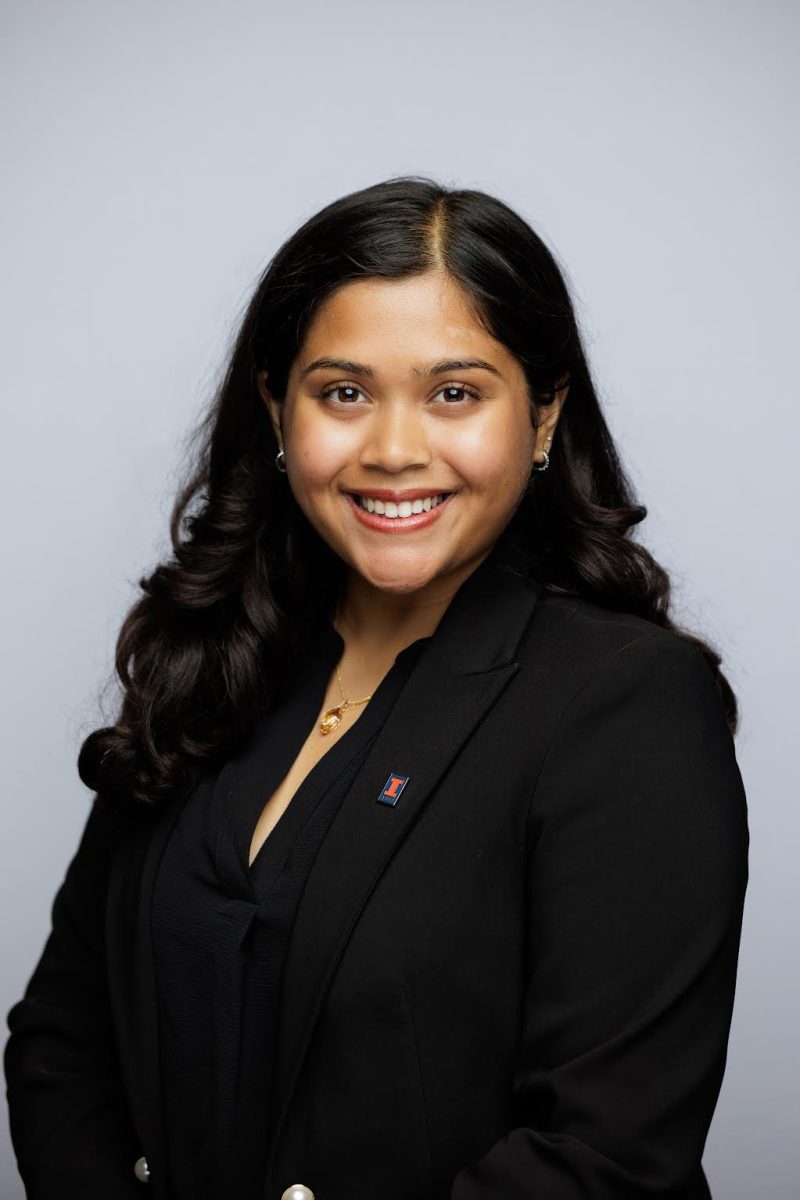
Ariana Mizan, student trustee and senior in Business, meets with the University of Illinois Board of Trustees — the UI System’s overarching governing body — on a biweekly basis. She also attends committee meetings and goes to executive sessions. There are three students on the Board of Trustees, one from each UI System campus. One of the three student trustees serves as a voting member of the Board of Trustees each academic year.
“Basically, the bare minimum as a student trustee is you show up to those meetings, exercise your right to vote,” Mizan said. “However, my opinion is that the role is much more than that … A lot of your impact happens between board meetings.”
Mizan mentioned conversing with students, visiting the campus cultural centers and attending events to get to know the campus community to better advocate for it.
The student trustee position is a separate entity from ISC, but building a working relationship helps ensure the offices are efficient with their resources and do not work counterproductively, according to Mizan.
Throughout her term, Mizan has primarily focused on fighting food insecurity. Currently, she is working to create a “Fighting Illini Fighting Hunger” event. Her team has met with the Student Affairs’ Student Success, Inclusion & Belonging team and various food pantries to discuss their plans, but they do not expect implementation of their plans until the fall semester.
Mizan said her team has also met with operations and dining services to discuss a restructuring of the dining dollar app.
Besides focusing on fighting food insecurity, Mizan launched a Student Leadership Symposium with more than 150 students in attendance. She also created multiple surveys to gauge student perception of various ideas, like meal plan experiences or campus expressive policies.
“This role is meant to be accessible,” Mizan said.
Students should ask questions and talk to their trustees, according to Mizan. She encourages people to run for student government positions, regardless of their experience. In her two years as student trustee, Mizan has loved exploring the different aspects of campus and its community.
“It’s been the highlight of my college experience,” Mizan said. “I’m ready to pass the torch, and I’m excited to see who’s next.”
Correction February 10, 7 p.m.: An earlier version of this article referred to the candidates as senators and representatives when, they are representatives only.