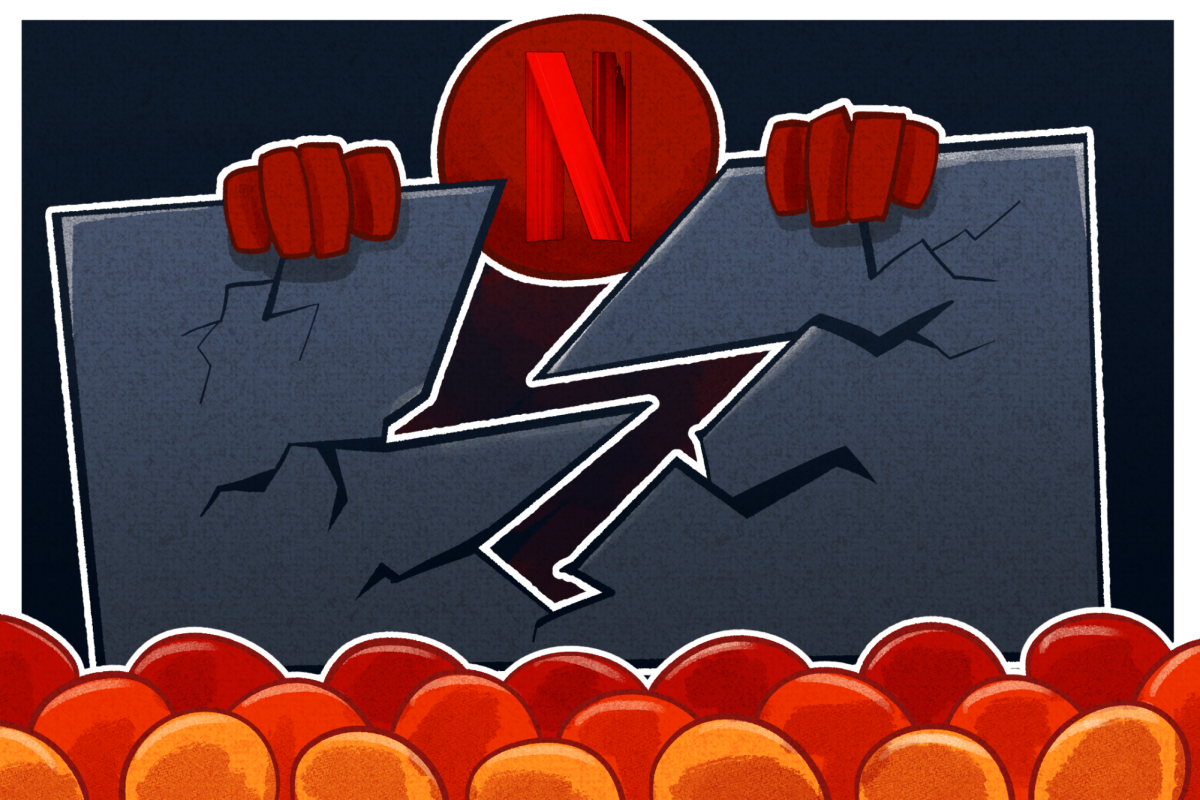
Starting as a humble DVD-by-mail rental company in 1997, Netflix has grown into a global streaming giant that rivals traditional Hollywood studios — and can now buy them, too.
The streaming leader has credited its growth to “building, not buying” since its origin. Despite this, the less than 20-year-old streaming service turned that motto on its head when it spent almost $83 billion to win a bidding competition over the 102-year-old film studio Warner Bros. Discovery, Inc.
The deal has sparked considerable controversy. Those who work in the film industry, such as writers, worry over the deal’s implications for job conditions and the volume and diversity of content for viewers. Politicians are concerned about how Netflix’s purchase of WBD would violate antitrust laws that prevent monopolization within various industries.
With 83% of adults in the United States now regularly using streaming services, the rise of streaming over traditional cinema has been a slow but steady one. Now more than ever, it seems we are getting closer and closer to a tipping point.
The Netflix-WBD deal is symbolic of something troubling: It’s another step toward the dismantling of movie-watching as a shared cultural institution.
Get The Daily Illini in your inbox!
Many, like the Cato Institute, have defended streaming as the democratization of film. They argue that instant access, convenience and personalization outweigh any possible drawbacks of movies moving from the big screen and onto laptops and phones. However, as streaming platforms consolidate power, it has become increasingly clear that what is being lost is not just box office revenue, but also the cultural meaning of watching movies entirely.
Film has never existed in a vacuum. Scholars argue that cinema both reflects society and actively shapes it, reinforcing shared values, anxieties and beliefs at particular historical moments.
When movies were primarily theatrical experiences, they operated within a collective framework: audiences gathered at the same time and place and submitted to the same screen, pacing and emotional arc. That shared act mattered.
What is often missing from industry defenses of streaming is an acknowledgement of the social dimension of movie-watching. Film historian Timothy Corrigan argues in his book, “A Cinema Without Walls,” that the event of movie-going has historically functioned as a social ritual — a date, family outing, shared memory or cultural reference point that helps shape interpersonal relationships and collective identity.
Streaming fractures that experience.
Box office revenues in the U.S. are a critical benchmark of cinema engagement and cultural buzz, which remains below pre-pandemic heights. Movie attendance has never fully bounced back after COVID-19 closures, and streaming’s convenience has only accelerated the shift homeward.
Long-standing theatrical release windows, once 90 days or more, have shrunk drastically. Some films now appear on streaming within weeks of their theater runs, reducing the urgency to leave home for a screening.
As media scholars warned decades ago, the shift of movie-viewing away from theaters and into private spaces disperses audiences both physically and culturally. Movies no longer “capture” viewers within a common set of expectations or meanings. They are instead consumed in isolation, interrupted, sped up, half-watched or are relegated to background noise.
When everything is available at once, nothing feels essential. When films compete with infinite content, they lose their ability to anchor a collective conversation.
Streaming companies are not curators of film culture; they are data-driven corporations whose incentives favor scale and retention over artistic risk or cultural significance. Preserving movie-watching culture requires protecting theaters, prioritizing theatrical windows and remembering that movies were never meant to be consumed the way we scroll through content.
Once movie-watching becomes just another solitary activity, the institution of cinema will not evolve; it will already have disappeared.
Theaters have survived every supposed death sentence thrown at them — television, VHS, DVDs — precisely because movie-watching is about more than access. It is about collective attention. The problem we are seeing today is not that streaming exists, but that Hollywood allows it to redefine the purpose of movies.
Streaming can coexist with theaters. However, deals like WBD’s agreement with Netflix suggest studios are interested in replacement rather than coexistence. If this continues, movies won’t disappear overnight. Rather, they will simply risk losing meaning, reduced to interchangeable content rather than shared cultural experiences that ask for and deserve our attention.
Gurneer is a sophomore in LAS.