If you’ve seen me on the street, I was probably in an Oxford-cloth button-down and chino pants. Make no mistake, cosplaying as an academic is a hobby I take very seriously. To maintain appearances, I make the rounds at many conferences, symposiums and seminars in the climate, energy and environment space.
I met Matt Soener, professor in LAS, at one such conference. His talk on the distributional effects of sustainable growth — how it is often pursued at the expense of the Global South — was enthralling.
I later signed up for his SOC 226: Political Sociology course, which I’m currently taking. Each class feels like a real seminar; it’s a much-needed palate cleanser after four years of pure economics.
There’s the contradiction: I’ve spent college chasing “useful” skills in economics, which, in practice, means taking math-heavy courses that I wouldn’t naturally reach for. This occurred at the expense of classes that I might have genuinely enjoyed.
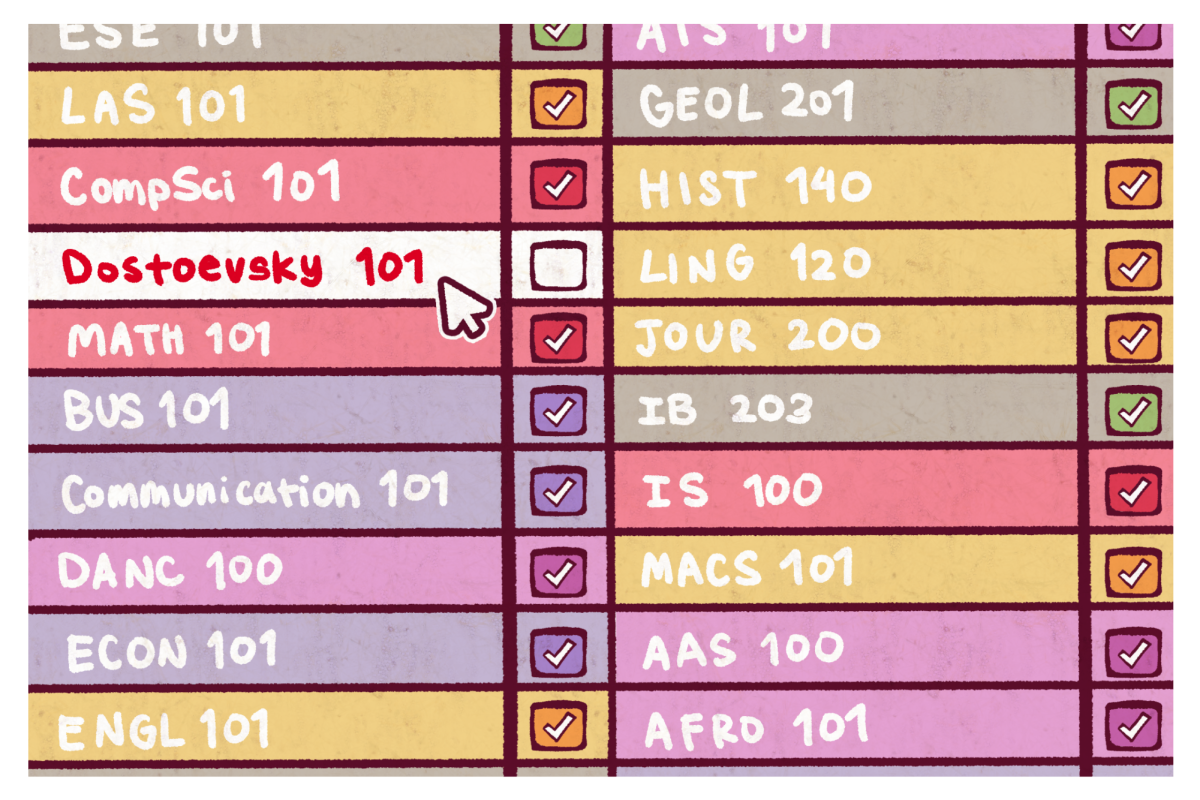
Like other students looking to optimize their education, I’ve relied on the data visualizations of Wade Fagen-Ulmschneider, professor in Engineering, to help decide which courses to take for my general education requirements. Through his famous “Every Gen Ed at UIUC, by GPA,” I could choose courses that satisfied multiple requirements, frontloading my gen eds in my underclassman years, leaving plenty of time to study “useful courses.”
Get The Daily Illini in your inbox!
What a mistake.
Don’t get me wrong, I’m a fan of gen ed requirements. They’re a vestige of college’s original liberal arts mission — pared down, sure, but still a way to push students into courses they’d never otherwise pick.
Coming into college, my biggest gen ed hurdle was the natural science requirement, which I was unlikely to encounter naturally. I took CPSC 113: Environment, Agriculture and Society, which oddly counted for “Western Culture,” and IB 110: Race and Environmental Biology, which covered the “U.S. Minority” credit while introducing me to environmental justice.
I chose both for efficiency — four requirements in two courses — but they shaped how I think. Crop science knowledge proved handy in my agricultural economics classes, and IB 110 grounded my understanding of environmental inequity. Maybe I’m living proof that the current status quo works.
That narrative might be true, except that I took MUS 133: Introduction to World Music, a gen ed that didn’t really stand to benefit me at all. I took it for the explicit purpose that it would be easy and satisfy my “Non-Western” credit.
I’ve come to think that the benefit I derived from CPSC 113 and IB 110 was primarily accidental. I would have been better off taking a suite of courses I might have enjoyed, interwoven throughout my college career.
Now, sitting in Soener’s class, I wonder how things might’ve gone if I’d said yes to that Dostoevsky seminar, or bookbinding, or natural resources or even ice skating — all the strange, interesting detours I passed up in the name of efficiency.
Why did I? Maybe because everyone else was optimizing, too. Maybe because the tools made it easy. Maybe because when you’re staring down debt and job pressure, it feels reckless not to.
College has turned into an exercise in risk management, an optimization problem with no room for error.
I’m grateful for Fagen-Ulmschneider’s tools, but they also make it tempting to treat education like a spreadsheet instead of an experiment. How many Reddit threads ask for “fun classes” in senior year? Some majors truly have no time earlier, but often, it’s just that people only realize too late that learning, for its own sake, has value — “education is wasted on the young,” as the line goes.
But even optimization is relative. Maybe it’s not just about fast-tracking gen eds to get back to economics. Maybe real optimization means choosing courses that add texture — that make your studies less efficient but more alive.
A class on Russian literature, for instance, might have helped me see the plight of working people amid market failures and weak institutions, much like Soener’s class now challenges how I think about my own field. I can’t help but lament the missed opportunity.
I’ve been thinking about how much I streamline my life — Notion templates, spreadsheets and color-coded Outlook calendar inclusive — all in the interest of saving time. But to save time for what? More scrolling, more idling?
On the contrary, it’s good to stay busy. A rigorous class — one that leaves you tired in a good way — proves that depth is always worth the cost, that attention is best used where ease would only skim the surface.
In the age of artificial intelligence, large language models are often a substitute for critical thought. A good gen ed is a check on that, by being a source of conceptual thinking. Wrestling with ideas is what keeps us human.
Out in the world, it’s rare to find the time or company to talk seriously about art, literature or culture. Indeed, there are real, adult responsibilities to contend with. Discussing the humanities is purely a leisure-time activity, which is in intense competition with a good Netflix binge.
College is one of the few places built for that kind of thinking. It’s optimized for it: You’ve got a captive audience and a willing expert. The internet will always be an imperfect substitute for the role college plays.
I’ve never understood the rush to leave. Why hurry past one of the last places where learning still feels communal?
So, if you have the time to stop and smell the roses and take a class on Dostoevsky or underwater basket weaving, I implore you to do so. That kind of detour might shape your thinking like Soener’s has shaped mine.
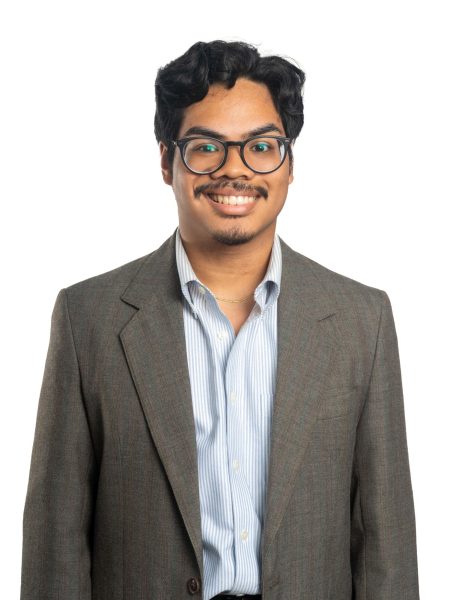
Raphael is a senior in ACES and is doomed to wander the groves of academe.