Starting a season with a new coach would bring bouts of uncertainty for anyone, but not when the coach is Kevin Battle, an experienced rugby veteran. The team is certain that Battle’s passion and knowledge of the game will take the group to the next level.
After being on the other side of the country for three decades, Battle decided to accept the coaching position in his hometown and reshape the men’s rugby program.
Battle’s background
Battle is a Champaign native, having graduated from Champaign Centennial High School in 1992. His first experience with rugby came while attending college in Santa Barbara, California.
“It was there I discovered rugby,” Battle said. “Or, rugby discovered me.”
His background in rugby is extensive. Illinois Rugby Football Club president Sam Schultz lists Battle’s experience as a key factor in the decision to welcome him to the team.
“He’s the most qualified coach we’ve ever had,” Schultz said. “He knows what he’s doing; it’s been a big change in the culture of what we’ve had here in the past.”
Battle coached at UC Santa Barbara from 2000-12. He also worked with the USA Development Team, Olympic development academies and Major League Rugby. In 2009, 2011 and 2015, he served on the coaching staff for the U.S. Men’s National Team in the 7s World Cup.
Since then, Battle had been working in coach development until the opportunity to coach collegiate rugby in his hometown was offered.
Putting IRFC to work
After obtaining the coaching position, Battle quickly began to institute new team initiatives and protocols. Rather than biweekly practices, the team now practices four times a week, along with early morning lift sessions three times a week. Team captain Jacob Razo is confident these new standards have already benefited the team.
“He brings a level of grit that we needed,” Razo said. “He’s definitely been an enforcer from a standpoint of fitness.”
Simply watching practice, it’s clear Battle expects a high level of tenacity from his team, as his critiques and encouragements fill the air. The high expectations are an aspect of Battle’s philosophy.
“It’s really about doing hard things,” Battle said. “The guys have to be willing to work hard for each other … to get up early … to be willing to make sacrifices. And I think that as they do that together, they’ll grow closer, they’ll learn to rely on each other more.”
Revamped ruggers
With a coach as experienced as Battle, there’s lofty anticipation regarding the direction IRFC is headed. Schultz is looking forward to the program being taken more seriously and competitively, and this team is determined to make it happen.
“In the past, it’s just been like a ‘club sport,’” Schultz said. “You know, just show up, play rugby if you want, walk away if you want.” He details that as a result of the improved coaching, the team is extremely committed.
“A little more time spent at the gym, a little less time spent out,” Schultz said.
Razo is just as optimistic about the future of IRFC. There are only a handful of seniors on the team, a majority of the roster being underclassmen with time to improve their skills.
“I’m honestly really excited for what they’re gonna have, because they’re gonna be able to have the groundwork we laid this year,” Razo said.
Building brotherhood
While the team is working hard and pushing themselves throughout practice, the sounds of laughter and motivational chants echo across the field. Sophomore Payton Sirota appreciates the way Battle has prioritized building camaraderie on the team.
“In the past, we would just show up to games separately,” Sirota said. “Now we do a team breakfast beforehand where we talk over our goals for the game — it’s been a massive help.”
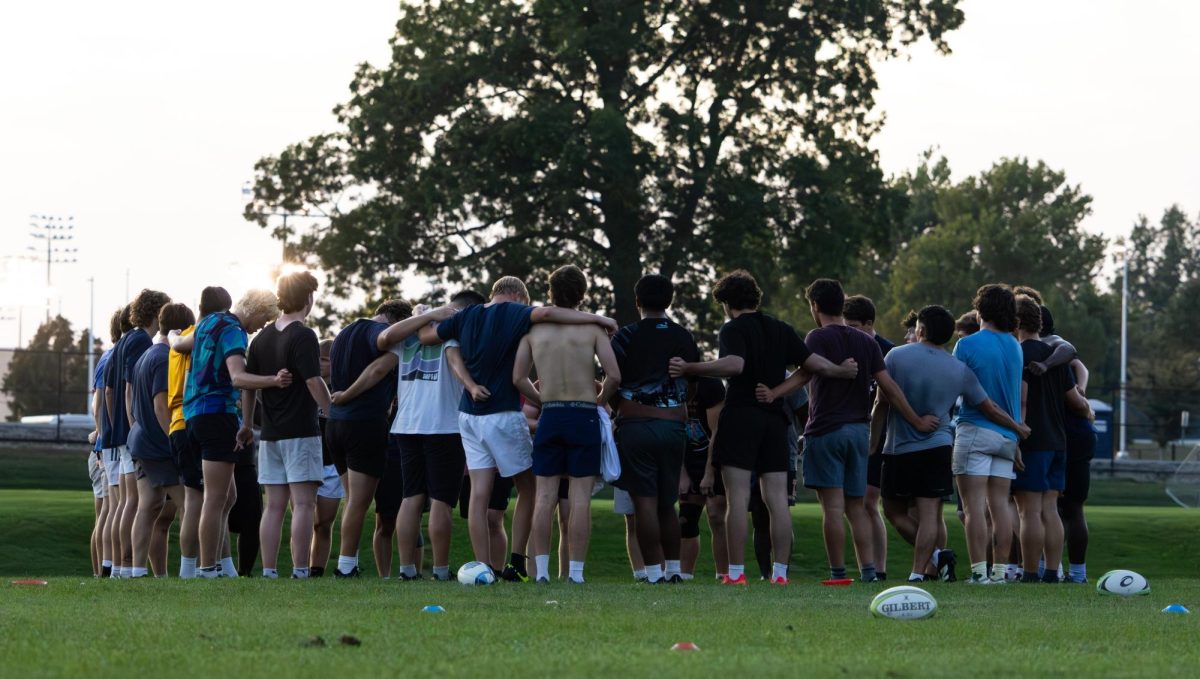
Schultz explains that Battle has introduced a team huddle at the end of practice where any player can express their concerns, rather than limiting it to only those who hold leadership positions. The huddle fosters a positive environment where anyone on the team can make their voice heard and acknowledged.
“The camaraderie has been really good — a definite improvement from what it was in the spring,” Schultz said. “Everyone was at each other’s throats, and we didn’t have a coach. We were just kinda out here knocking heads at practice and just hoping for the best.”
An increase in brotherhood is most important to the team; many of them deeply appreciate just how much the team means to them.
“I love being around this team,” Razo said. “Outside of practice, we’re probably together every weekend and then basically anytime we can (be). I know I’m going to have 60 brothers for life.”