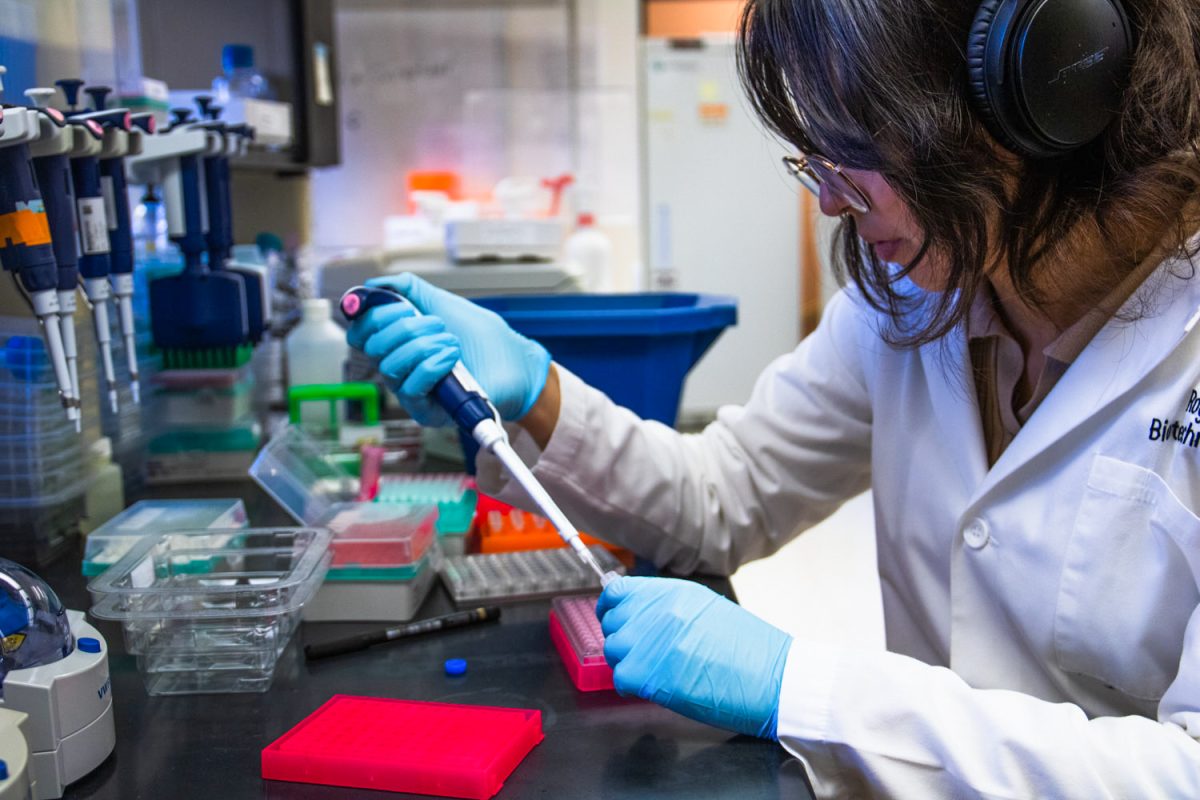
When people think of research, they probably picture microscopes, lab goggles or someone mixing liquids in a glass beaker. While that’s part of it, research at the University can also mean programming evolution models, analyzing cancer disparities, engineering human cells and conducting thousands of other experiments. In many of these projects, undergraduates play an active role.
With annual research funding growing past $700 million in recent years, the University enables students to contribute to impactful work. Upon doing so, they improve their skills and confidence.
Jenny Zhu, junior in LAS, initially searched for research opportunities within her department — molecular and cellular biology — but was discouraged when her cold emails went unanswered or were met with a lack of open positions.
Encouraged by her roommate, who studies materials science and engineering, Zhu expanded her search and emailed Hua Wang, a professor in that department with a biology-related lab. Zhu received a positive response from him.
“Sometimes you just have to be persistent,” Zhu said. “I took a chance … and that’s how I ended up joining the Wang Lab.”
Get The Daily Illini in your inbox!
The Wang Research Lab is engineering human cells to improve immune responses to diseases, including cancer. Experiments don’t always go as planned. However, Zhu values the adaptability she’s attained from this experience.
“Learning from (when experiments go wrong) — troubleshooting — is a huge part of research,” Zhu said. “Building that problem-solving skill is really valuable even beyond the lab.”
Balancing research and coursework is a challenging task. To achieve this, Zhu emphasizes the importance of time management. She said she’s built lasting relationships with her labmates and enjoyed the process of learning and asking questions.
Cancer research at the University isn’t just confined to biology or engineering labs. In ACES’ Department of Food Science & Human Nutrition, professor Zeynep Madak-Erdogan’s Women’s Health and Metabolism Lab is investigating cancer disparities. She uniquely focuses on how social and environmental factors influence one’s health.
Hannah McGee, senior in LAS, works in Madak-Erdogan’s lab. The team connects molecular and cellular biology — McGee’s major — with metabolic and neighborhood-level influences to uncover drivers of cancer outcomes.
“When I started college, I wasn’t interested in research,” McGee said. “It sounded so boring.”
But an assignment motivated her to contact Madak-Erdogan, whose work resonated deeply with what McGee experienced growing up in Chicago. It was the first time she felt a genuine connection to research.
“I found papers that interested me and connected (to) my own life,” McGee said. “I emailed her and, within a day, she responded.” She credited the positive response to showing her genuine interest in the work and citing examples of papers the lab published.
McGee has spent over two years in the lab. Growing her research portfolio, she’s contributed to publications and presented her work at symposiums. Each time, her confidence grows.
“Putting yourself out there and presenting really improves public speaking skills — the way I present myself and convey ideas,” McGee said.
For McGee, conducting research has been “free career development” — an opportunity to gain valuable skills without a cost.
“I’m giving my time, and I’m getting all these skills that are so valuable to my own development and so valuable to other people, like employers,” McGee said.
In another corner of campus, Mohammed El-Kebir, professor in Engineering, was honored last year for excellence in mentoring undergraduate research. El-Kebir leads a computational biology lab on reconstructing tumors’ evolutionary histories. It is a complex challenge given diverse mutations and fragmented genomic data.
His lab attracts computer science and biology students. El-Kebir said there are computer science students who were never interested in biology before. Similarly, he said there are biology students who became interested in the computer science aspect of the lab’s work.
El-Kebir encourages students to establish connections with professors via courses rather than cold emails. Cold emails have a lower success rate in landing research, he said.
“The professors that do research typically teach upper-division courses with a research project, and that’s a good opportunity to start working together,” El-Kebir said. “That’s the more natural choice.”
According to El-Kebir, all undergraduates should try researching for at least a semester. He said it helps them develop unique skills and gain recommendations from respected professors.
“Research requires a variety of skills that you don’t typically apply in a classroom setting,” El-Kebir said. “Even if you’re not going to end up going to grad school … companies can be very interested in that. It’s good just to be exposed to something outside of classwork.”