Give people one small decision before the outcome appears, and the whole experience feels different. They stop feeling like spectators. They feel involved. And that feeling can be strong even when the “choice” doesn’t improve the actual odds.
Why small choices feel so convincing
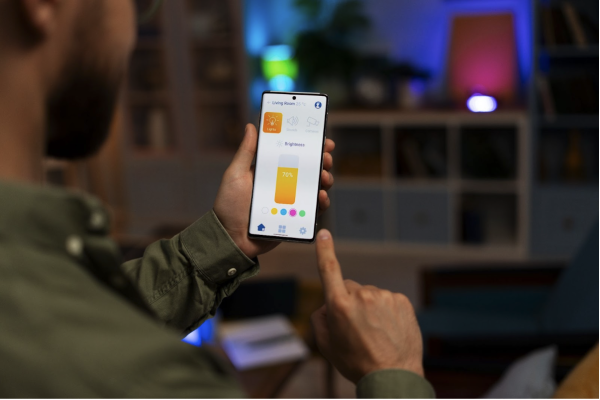
The illusion of control isn’t about someone being foolish. It’s about how the brain handles uncertainty. When an outcome is random, the mind wants something to hold onto. A button, a mode, a timing moment, a setting-anything that looks like a handle.
A sense of control makes uncertainty easier to sit with. When there’s a choice, waiting feels less tense, because the person has done something. That small action turns “I’m just hoping” into “I’m participating,” and participation feels calmer than helplessness.
There’s another quiet effect too: once someone chooses, the brain starts explaining the result through that choice.
Before the examples, it helps to see the most common thought patterns this creates:
Get The Daily Illini in your inbox!
- If the outcome is good, the choice gets credit. It feels earned.
- If the outcome is bad, the choice becomes the obvious thing to change next time.
- After a few rounds, people start building personal rules, even when nothing in the system supports those rules.
None of this requires a “big belief.” It’s enough for the option to look meaningful.
The easiest way to make options clearer
A lot of confusion comes from mixing different kinds of settings together. Some options change the feel of a session. Some only change speed. Some are pure convenience. When they’re all thrown into one menu, people naturally assume they’re all strategic.
A simpler approach is to group options by what they actually do: some change how sharp or calm the session feels, some change the pace, and some are just about comfort. This shows up across many digital products, including casino sites.
On Spinrise, for example, it’s easier to tell the difference between tweaks that affect the flow of play and tweaks that simply make the interface nicer to use. It’s a small design detail, but it matters: when options are presented plainly, people are less likely to treat every click like a hidden strategy.
The same idea shows up outside gambling too. A music app separates sound quality from visual themes. A trading app separates order types from chart colors. When products do this well, users still get choice, but they get less confusion along with it.
Where the illusion is usually “built in”

The illusion of control tends to appear in the same places, because the brain reacts strongly to timing and feedback. The closer an option sits to the moment of the outcome, the more it feels like it must matter.
To keep this practical, it helps to sort “control” into a few simple buckets. The goal here isn’t to accuse any feature of being bad. It’s to separate control over the experience from control over the result.
Before the table, one key idea: most options do not change luck. They change rhythm, comfort, or how intense the swings feel.
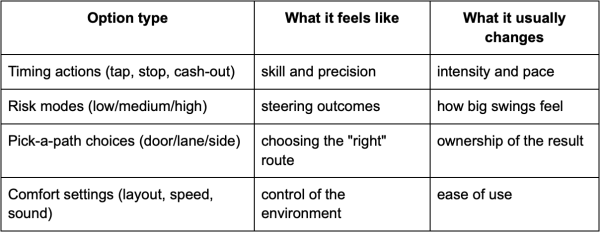
This is why timing buttons are so powerful. Fast feedback makes people feel like their action caused the outcome, even when the system is not actually responding to reflexes in any meaningful way.
Risk modes work differently. They usually don’t promise “better” results. They change how the session behaves. When people choose a higher-risk mode, they often feel more responsible for what happens, because they chose the ride.
Pick-a-path choices add something else: commitment. Once a person picks a lane, the outcome feels personal. It becomes their route, their call, their story.
A simple reality check that doesn’t ruin the fun
People often want a quick way to avoid fooling themselves, without turning the experience into math homework. The easiest check is surprisingly plain.
If someone else pressed the same buttons at the same moments, would the outcome reliably improve?
If the honest answer is “probably not,” then the choice is likely about comfort or engagement, not advantage.
A few practical rules help keep expectations clean:
- Options that change pace or visuals can still matter, but they matter for comfort, not probability.
- Options that change risk level usually affect how wild the session feels, not whether it is “better.”
- The closer a choice is to the reveal, the more it tends to influence confidence rather than the result.
When products separate these categories clearly, people tend to play more steadily. They stop chasing a “perfect setting” and start using options for what they’re good at: shaping the experience.
Final thoughts
Choice is engaging because it turns waiting into participation. That shift alone can make outcomes feel more meaningful, even when the odds haven’t moved an inch. The illusion of control doesn’t need a grand misunderstanding. It only needs a believable handle and quick feedback.
The healthier takeaway is simple: most options control rhythm, comfort, and how intense a session feels. They rarely control luck. When that line is clear, people can still enjoy choosing without turning every click into a “strategy.”