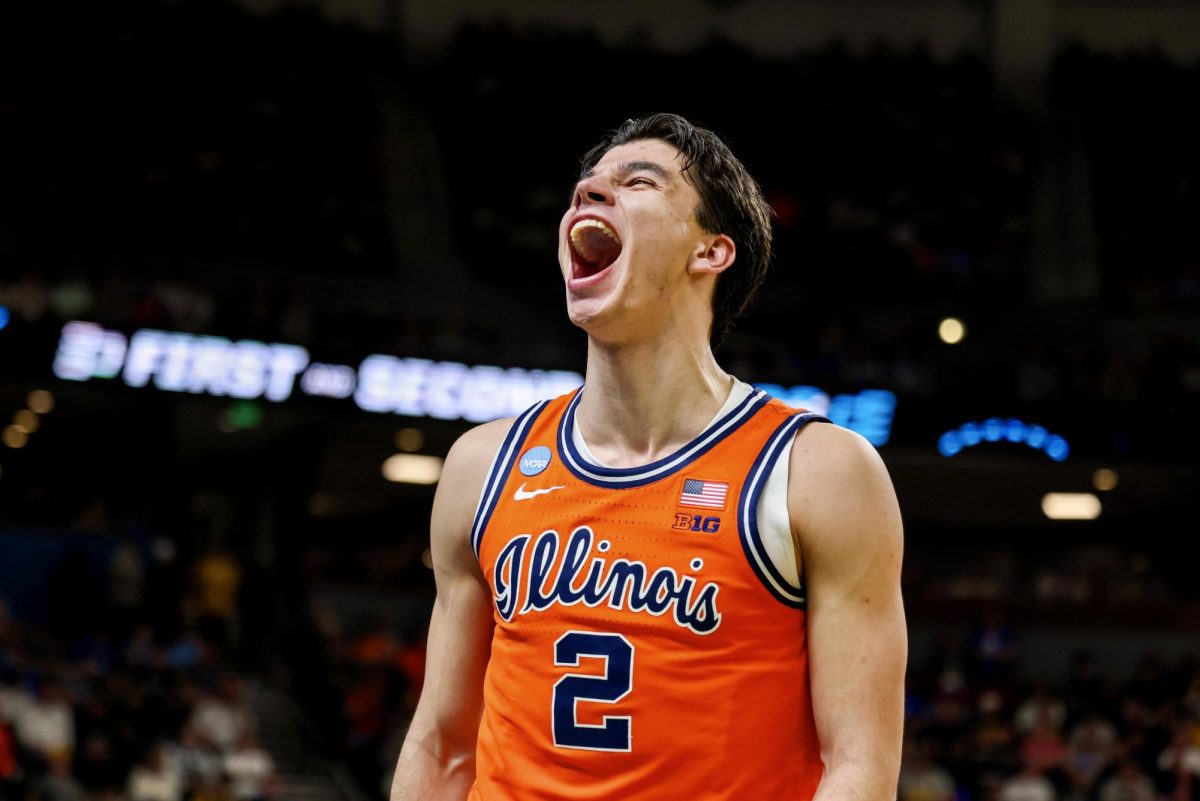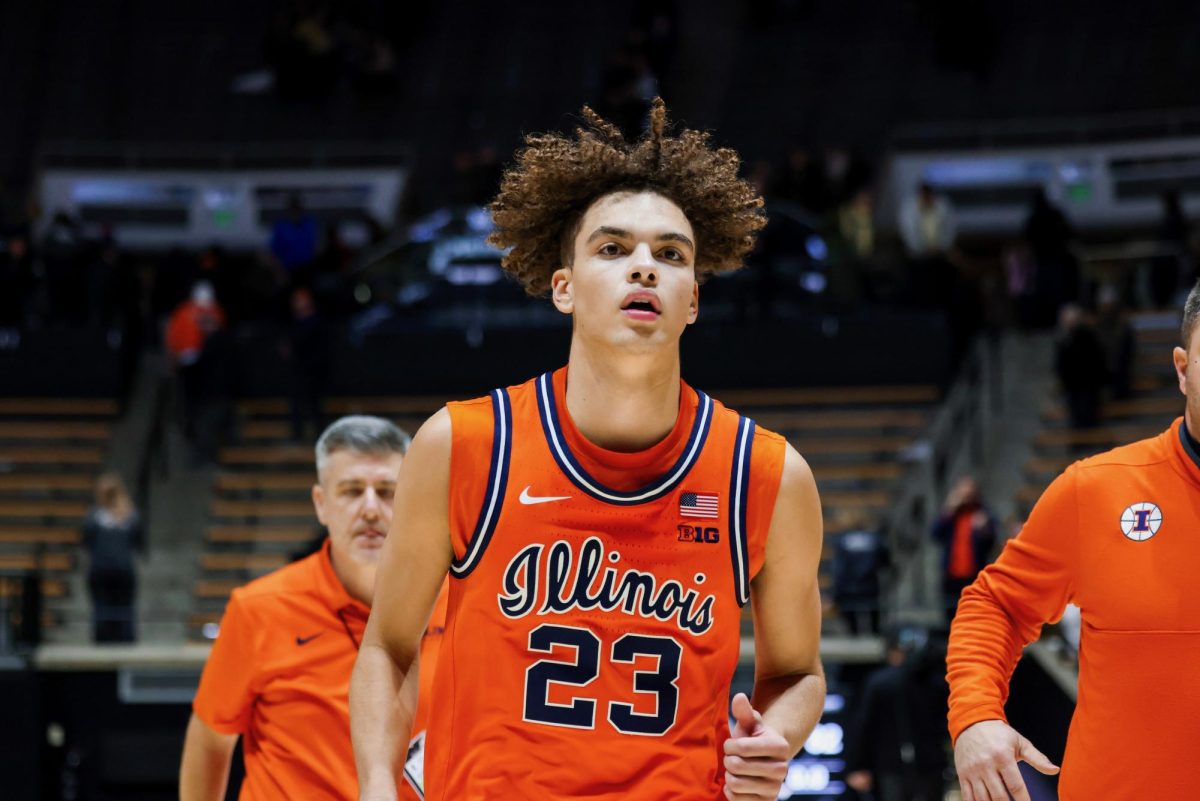
No. 5 Illinois’ (20-4, 11-2) 12-game winning streak came to an end in East Lansing, Michigan, on Saturday night as it fell in overtime to No. 10 Michigan State (20-4, 10-3), 82-85. Even on a tough night from the field for star freshman guard Keaton Wagler, other Illini stepped up amid his struggles, but it still wasn’t enough to overcome the Spartans on the road. Redshirt sophomore guard Jeremy Fears Jr. ran the show for Michigan State until the final buzzer, recording a 26-point, 15-assist double-double, including scoring 11 of Michigan State’s 14 points during overtime.
Although junior forward Jake Davis knocked down two free throws after getting fouled on an offensive rebound near the end of regulation, it was all Fears in the extra five minutes. The Illini couldn’t find a defensive answer for Fears at the end of the game, as he was able to create shots for himself in the lane as well as get to the free-throw line at a high rate. Allowing offensive rebounds and struggling to knock down field goals in clutch moments also led to Illinois’ fourth loss of the season.
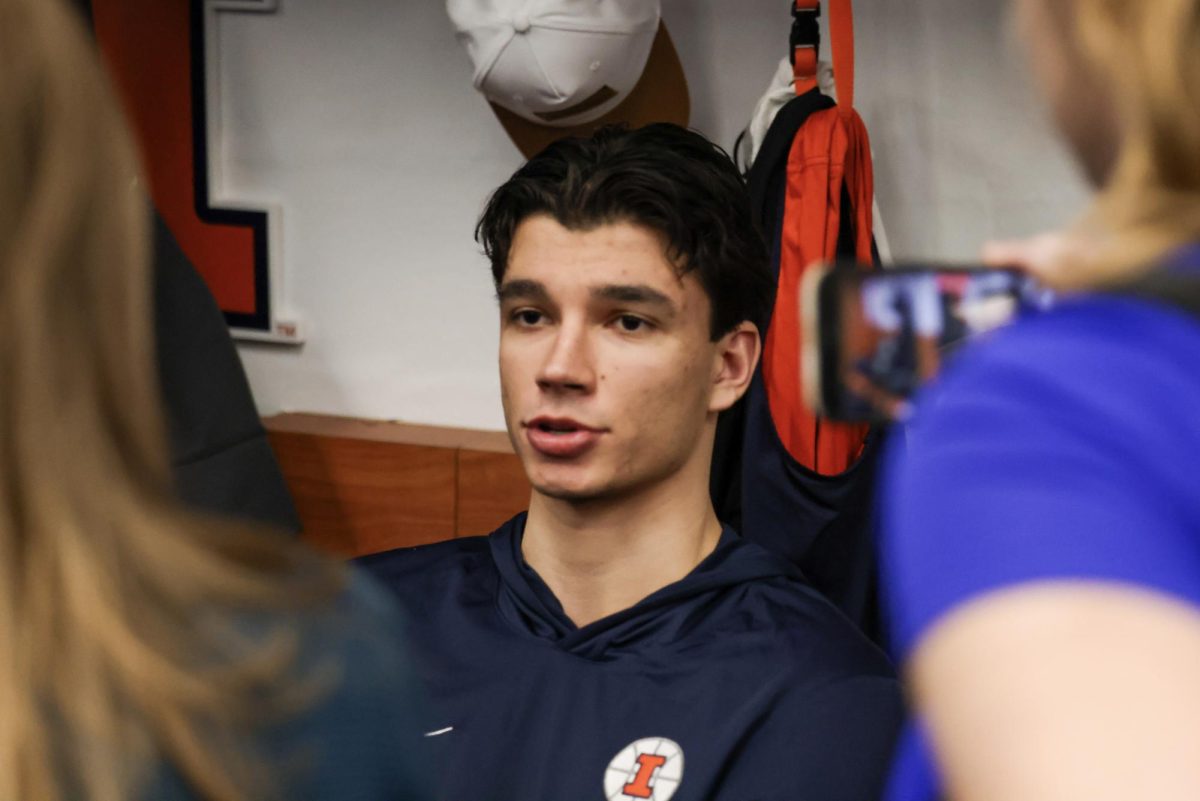
“That’s a distraught locker room,” said head coach Brad Underwood. “I mean, there’s a bunch of guys that have a lot of desire and want and care … There’s another one on Tuesday.”
Spartans find an answer for Wagler
From the start, Michigan State made it known that it wasn’t going to be an easy night for Wagler. While the Spartans weren’t throwing double teams at Wagler as Northwestern did on Wednesday, they didn’t lose Wagler in half-court situations and didn’t give him much space the entire night. Wagler had to work for every attack at the rim he had coming off his usual ball screens as Michigan State’s stronger, more physical defenders stopped him in the action.
Get The Daily Illini in your inbox!
Since the start of the season, Wagler hasn’t struggled to perform at a high level against physical defenses such as the one he faced on Saturday and has found ways to adapt to different defensive ball screen schemes. However, he couldn’t get into an offensive groove, finishing at the rim or consistently hitting 3-pointers, since the Spartans didn’t leave his side for most of the night. The freshman’s decision-making in the lane also wasn’t up to its usual standards as Wagler took multiple contested shots in traffic that he could’ve passed off for better options.
“He was due,” Underwood said about Wagler’s performance. “It’s just the law of averages. They did a good job. I’ll give them all the credit.”
After going scoreless for almost the entirety of the first half, Wagler finally scored his first points of the contest on free throws with under a minute left in the half. In his offensive absence, it was a complete team effort from the Illini to keep the game tight through the first 20 minutes, and they did just that, heading into halftime with a 4-point lead. While Illinois’ frontline brought its usual versatility, going to work by the basket and knocking down threes, graduate student forward Ben Humrichous provided a much-needed spark off the bench as he put up 8 first-half points.
Wagler got himself going a bit more offensively coming out of halftime, as he figured out how to work against Michigan State’s physicality by earning trips to the free-throw line. While Wagler didn’t score at the rim at a high rate by any means, his persistence drew fouls. Of his 16 points in the game, Wagler scored 10 of them at the charity stripe, going 10 for 12. On the other hand, Wagler went 2 for 19 from the field, one of his poorest shooting nights of the season. The mix of Michigan State’s physicality and an inability to hit tough shots caused Wagler to fall short and, in turn, put Illinois at a disadvantage.
“Tonight, they didn’t go down,” Underwood said. “Keaton got some really good looks, and that’s just the game of basketball. We like to be good at offense, but we haven’t built our program on that. We try to win games when the ball doesn’t go in.”
Illini fall short in rebounding battle
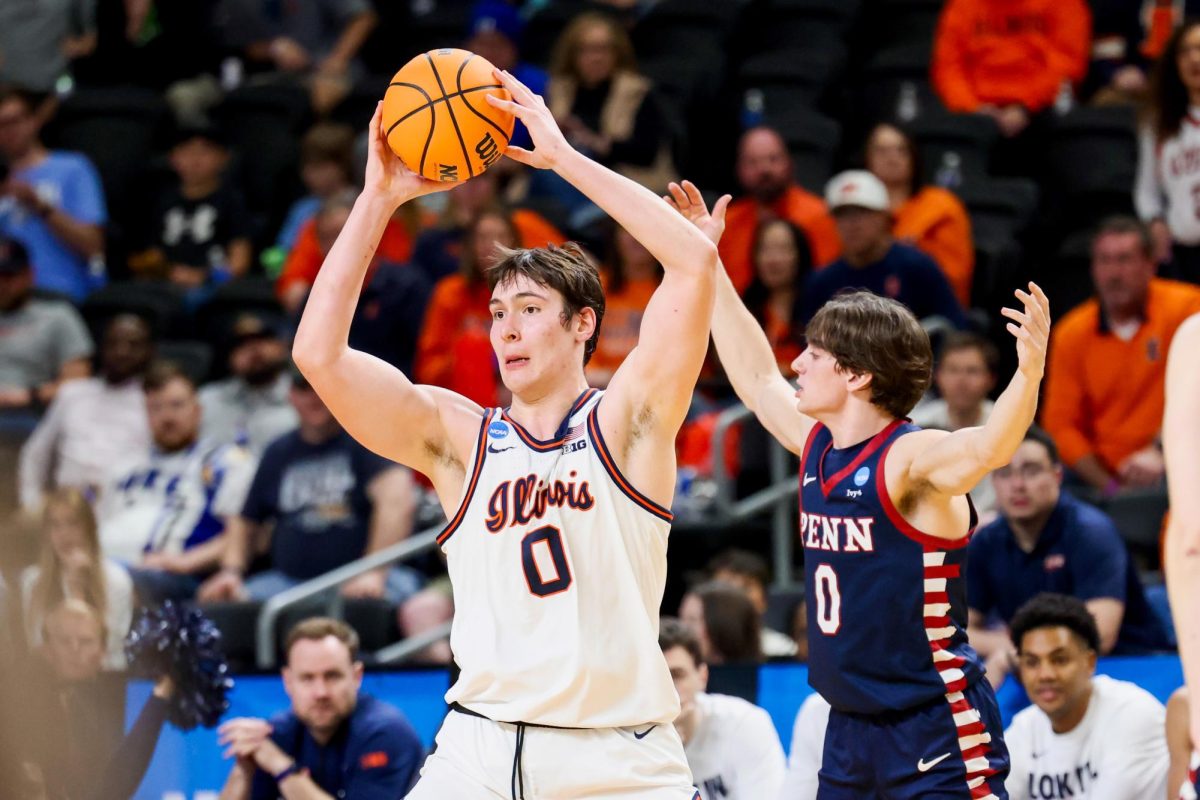
Going into this matchup, Underwood and the Illini knew it was going to be a hard-fought, physical battle on both the offensive and defensive glass. Similar to Illinois, Michigan State is an active offensive rebounding team, and it proved that from the jump on Saturday night. The Spartans started the contest with a bigger lineup alongside Fears, which gave the Illini trouble rebounding throughout the beginning of the game. In just the first half, senior forward Jaxon Kohler grabbed three offensive rebounds to lead Michigan State, while senior center Cooper Carson and junior forward Coen Carr recorded two apiece.
The Spartans’ activity on the glass led to a few costly early fouls against the Illini, but they eventually began matching the Spartans’ intensity on their own end of the floor. Illinois recorded more first-half offensive rebounds than Michigan State, with nine, thanks to the effort of Humrichous, freshman forward David Mirković and junior center Zvonimir Ivišić. The Illini also scored double the number of second-chance points as the Spartans in the first half, with 10 compared to their 5. In terms of executing its game plan on the boards, Illinois was on the right track after an early slow start.
Across the whole game, the Illini didn’t let up on their offensive rebounding efforts, but the Spartans edged them out on the defensive glass, 33 to 23 by the end of the second half. For Illinois to win this matchup between two of the nation’s top rebounding teams, it couldn’t fall short in the rebounding battle against Michigan State, especially on an off-shooting night from Wagler. The Illini ended up allowing Kohler to put up an 11-point, 16-rebound double-double, and it made all the difference in the game’s outcome.
“They won the rebounding battle,” Mirković said. “I mean, they were physical. It was really physical game. A lot of contact. They were just better today, and that’s it.”
Michigan State’s transition points are an X-factor
Along with its rebounding, Michigan State gives itself an advantage over its opponents by capitalizing on their missed shots and on the opportunities that arise in transition. To no surprise, that was no different against Illinois. Compared to the Illini’s 0 fast-break points, the Spartans scored 22 points in transition, which gave them an automatic advantage in the matchup. Michigan State’s forwards and centers were quick to run the floor after each miss, and Fears used his impressive court vision to find them in the open floor.
With senior guard Kylan Boswell still sidelined, junior wing Andrej Stojaković took on the assignment of defending Fears. On each Illini miss, Fears was automatically finding the ball for an outlet to get the ball up the floor. As Stojaković took more of an offensive load as Wagler struggled, he found himself near the rim, where his offensive strengths lie, and not down the floor where Fears was. Fears got the advantage in transition, and neither he nor his teammates fell short on their home floor. The most impressive example of how dangerous Michigan State is in transition came in the first half when Fears threw a lob from half court to Carr for a monster backwards dunk.
As Illinois shot 36.6% from the field, including 27.8% from 3-point range, Michigan State got plenty of opportunities to show off its talent in transition on Illinois’ misses. It also played a rotation of 10 players compared to Illinois’ rotation of seven, which gave Michigan State fresh legs throughout the game, whereas Illinois didn’t have that. The Illini weren’t as quick to react to the Spartans’ transition play at points throughout the game, and they used it to their advantage, especially Fears, as one of the country’s leaders in assists per game.
Mirković, Stojaković carry Illinois’ second-half offense
During Illinois’ string of games in its winning streak, Wagler consistently established himself as someone Illinois can rely on in the big moments of these top-10 matchups. As Michigan State was doing everything it could to take Wagler out of his rhythm, other Illini needed to fill that void, and two of them did in the second half. When Wagler wasn’t getting to the free-throw line, Mirković and Stojaković put Illinois’ half-court offense on their backs and didn’t succumb to Michigan State’s physicality.
In recent games, Underwood has taken Wagler off the ball at times and had Mirković bring the ball up the floor. This has taken the pressure off Wagler to handle the ball against high-pressure defenders and instead has Mirković bring it up against players who don’t naturally guard on the perimeter. With Mirković’s court vision and improved ball handling from the beginning of the season, he not only led the Illini with 18 points but also dished out six assists with zero turnovers. Down the stretch, the offense ran through Mirković like he was a point guard, and it helped Illinois find scoring opportunities when it desperately needed them.
Mirković still put the pressure on the Spartans to defend him in the paint as well as the perimeter. The freshman didn’t back down from the size or physicality of Michigan State’s defense and hit contested shots in the lane, finishing well at the rim. Although Mirković went 1 for 5 from 3-point territory, an area where he’s excelled recently, he made up for it with his tough finishes, including a left-handed driving layup that gave Illinois a 1-point lead with 30 seconds left in regulation.
“We can use it as a strength moving forward,” Stojaković said about Mirković’s ability to bring the ball up the floor. “We’ve shown that it hurts teams. You know, today I thought it worked well, and we’ll have a chance to mix it up more.”
As for Stojaković, he was as efficient as he’s been from the field as of late, shooting 8 for 14, including 1 for 2 from three. Stojaković wasn’t fazed by Michigan State’s defense and got himself to the rim without turning the ball over. The junior was also patient on the offensive end, finding the right opportunities to slash the lane without forcing shots. Even without shooting a single free throw in the contest, Stojaković finished with 17 points, proving he can create shots for himself against some of the best defenses in the Big Ten. However, even solid offensive performances from Stojaković and Mirković weren’t enough to overpower the Spartans.
Overtime
After Davis’ free throws at the end of regulation, the game was tied at 71 apiece between the Illini and the Spartans. Yet, overtime was dominated by Michigan State, and that was because of Fears. The redshirt sophomore scored the first points of overtime right away on a driving layup, soon after the Spartans won the jump ball, and he was off to the races from there.
“I was disappointed in the fact that we fouled (Fears) that much,” Underwood said. “He’s not a very good shooter, and we wanted him to have to shoot the ball, even if it was a layup, but he’s crafty.”
On Michigan State’s next possession, Carson grabbed an offensive rebound and got fouled, heading to the free-throw line where he made one of his two attempts. Illinois then went down to the other end, and junior center Tomislav Ivišić knocked down a triple on the left wing to tie the game up at 74-74. A turnover by the Spartans on the next possession allowed Wagler to get down the floor, and Fears ended up sending him to the free-throw line, where he knocked down two free throws to give the Illini a 2-point lead.
The turning point of overtime happened on the possession following that, though, when Tomislav fouled out of the game by picking up his fifth foul on a Fears drive. Fears went on to score the next 5 points for Michigan State and put the momentum in its direction for the remainder of overtime, knocking down four more free throws in the final 20 seconds of the game. With six seconds left, though, Wagler hit a deep three that cut Michigan State’s lead to three and proceeded to get a steal on the inbounds pass, but Illinois didn’t hit the 3-point shot with time running out to send it to double overtime, sealing Michigan State’s victory.
@evy_york2