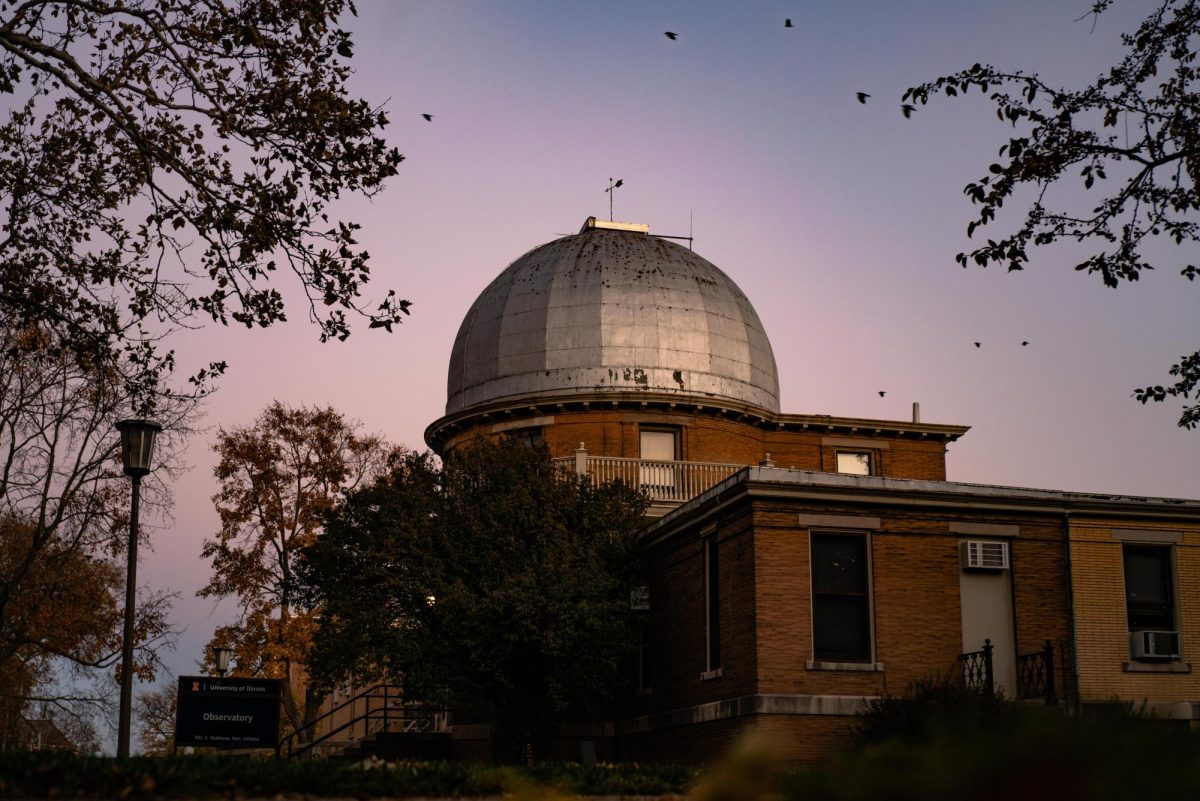
Two years ago, a passing daydream sparked what would become the newest artwork displayed inside the 129-year-old University of Illinois Observatory. For Eryn Van Wijk, junior in LAS, it began with a fantasy that felt almost surreal.
“I just sort of had this vision of an open house, and a bunch of personified stars coming down and greeting people,” Van Wijk said.
That early vision would eventually grow into “When the Stars Come Down to Greet Us,” a digital illustration displayed inside the historic dome, complete with QR codes, layered animations and interactive elements designed to educate the audience on the stars and planets around us.
This idea was born during Van Wijk’s summer experience as a resident artist in physics, which then sparked into a full project, blending astrophysics, mythology and digital illustration.
“We are always happy to have people come and showcase their art,” said Varun Satish, senior in LAS and president of the Astronomical Society. “When Eryn came to me and said, ‘Hey, I made this art for my residents in physics class, can I hang it in the observatory?’ I said, ‘Yes, of course, that would be wonderful.’”
Get The Daily Illini in your inbox!
For Van Wijk, the Observatory is a place where science and wonder exist side-by-side.
“(The observatory) was the first place on campus that I was really enchanted by,” Van Wijk said. “It’s an old building with a lot of history, and it gives you eyes out to the universe. The people here have been super lovely, (the observatory) has always felt so warm and inviting to me.”
Capturing that warmth became a guiding intention for the piece.
To create the piece, Van Wijk began with a positional draft by mapping out which stars and planets would be included, and where they would be placed, along with a rough sketch of the Observatory from memory. They created the background using overpainting, which is when a more refined layer is painted over a rough sketch. Then, they utilized Google Images to get the correct dimensions of the Observatory.
“I did this all from looking at various images of the Observatory available on Google Images,” Van Wijk said. “Then, I went to campus and finished this up with more edits.”
As the tentative structure took shape, Van Wijk began to weave in details that made the painting more representative of the community that frequents the Observatory. One of the first choices was symbolic.
“The stars that are greeting people from the balcony are an orange and blue stellar binary,” Van Wijk said. “Since those are the University’s colors, I thought that having them on the balcony greeting everybody would be really cool.”
From there, Van Wijk expanded the piece to include more personal touches connected to the Astronomical Society, an RSO that hosts the Observatory’s open houses.
“I was polling members on what their favorite stars were,” Van Wijk said. “I included those stars because I wanted a connection to the club to be present. I wanted it to feel like the club’s interests and the public’s interests merging together to show this sharing of things which people find cool.”
Some of these details are only visible to those who know to look for them. For example, the background of the painting contains a magnified version of Pleiades, an open star cluster in the constellation Taurus, which is a favorite among club members.
This piece immediately brightened the space.
“Normally, the Observatory is very drab, so to speak,” said Jack Haffner, junior in LAS. “But all the colors (in the painting) really stood out to me, especially because it contrasted with the Observatory in the painting itself. I think it really brightened up the space.”
This piece is not only visually engaging, but it is also a way for the viewers to learn more about astronomy. Alongside the physical piece, Van Wijk built a website where viewers can click on individual stars and view hyperlinked websites. These linked websites explain more details about different stars, such as how each star is classified and where it can be found.
“I would hate for people to look (at the painting) and wonder about what each star is and have no way to figure that out easily,” Van Wijk said. “Another thing I wanted to do was make this maximally publicly accessible, so that if a viewer was interested in stars and how I was representing them, they could click and learn more about the stats and mythology (for each star).”
Many of the details in the painting point to the interdisciplinary thinking behind the project.
As an astrophysics and philosophy dual major, Van Wijk found that both of these disciplines ended up making their way into their piece.
“I’m extremely interested in the connection between scientists and the public, and how communication goes between them.” Van Wijk said. “This painting is a bastion of that. The way we do (communication with the public) here is through open houses. I really like the dynamic there, and how we can interface with the public and the magic that comes with that.”
Open houses are an initiative that the Observatory hosts every month in order for students and the broader Champaign-Urbana community to engage with the Observatory. Members of the Astronomical Society primarily staff these events.
“(Open houses) gives us an opportunity to remind the public of why the Observatory exists,” Satish said. “A lot of the antique instruments we have played a very important role in the development of astronomy … and (open houses) are an important outreach tool that gives us a better chance to engage with the general public.”
Many students also see the artwork as part of a broader trend of student involvement.
“It’s always good to take artwork from the community and put it up in the Observatory,” Haffner said. “It really shows that it is students that are taking on the legacy of the observatory, and that we are still actively able to make changes going forward.”
This piece has not gone unappreciated by the public. Members of the public have been genuinely impressed by the piece, with many reacting with disbelief that this piece was made by an undergraduate, according to Satish.
Ultimately, Van Wijk wants people to look up at the sky intentionally.
“I’d like for people to be curious about what they are seeing when they look up, and have questions about past people that have seen the same night sky as them,” Van Wijk said. “Really just looking up with the right sense of wonder and curiosity that’s led to all of these technological discoveries and cultural moments.”