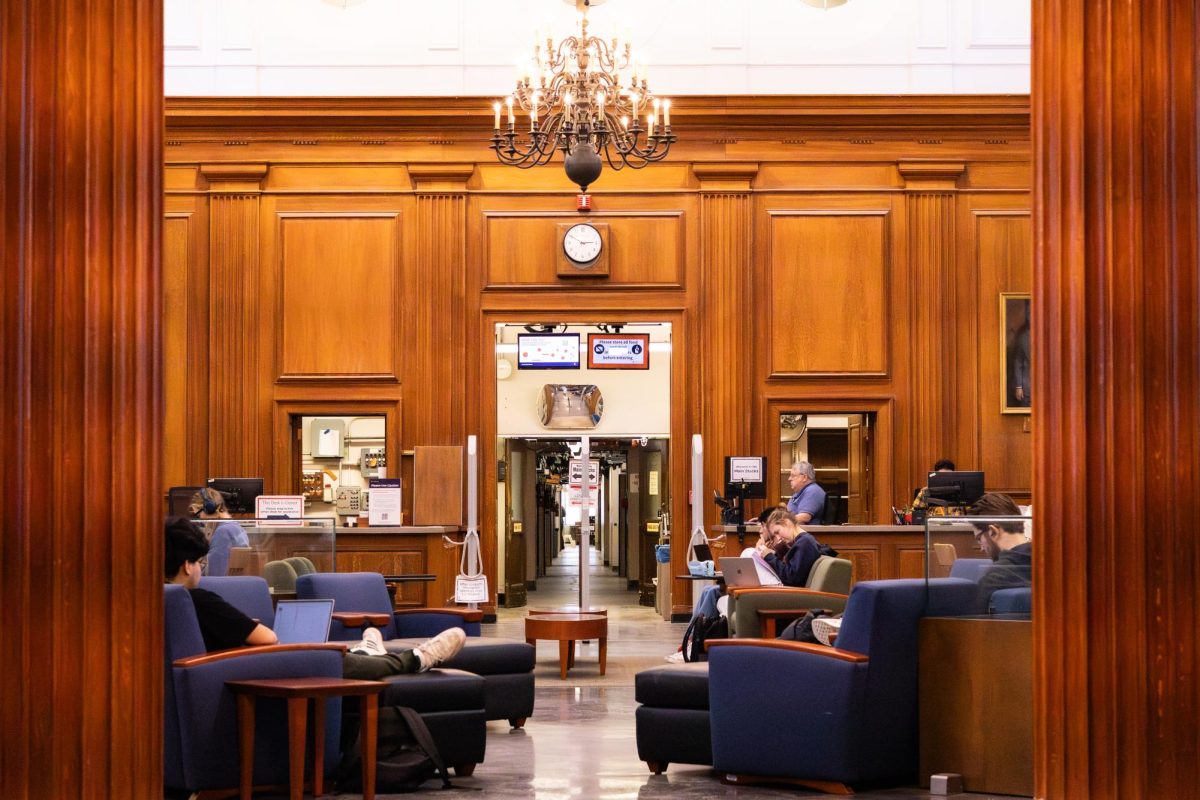
For many University students, what’s tucked behind the receptionist desks and security gates on the second floor of the Main Library is a place of mystery.
The Main Stacks collection — a sprawling, 10-floor collection housing approximately 3.7 million volumes — begins with an unassuming doorway into what feels like another world. Because the Stacks are not part of the Library’s open, supervised areas, students must stow their bags in lockers and swipe their i-cards for entry.
The Main Stacks are “the largest browsable patron-accessible collection storage location,” according to Tom Teper, associate University librarian for collections, assistant dean of libraries and head of preservation.
Depending on the discipline its borrowers belong to, the Stacks can serve different roles. For some, the Main Stacks collection may be the primary point for obtaining materials in certain fields. For others, the Stacks house materials that are valuable but less immediately integrated into coursework — for many scholars, more relevant materials may be located in a departmental library within the Main Library, like the History, Philosophy, and Newspaper Library.
“What you’re going to find in the Stacks is actually a material that helps support a deeper exploration of the topic,” Teper said.
Get The Daily Illini in your inbox!
What ends up in the Main Stacks is largely determined by subject specialists. According to Teper, when librarians acquire new materials, they decide whether those items belong in a departmental library — such as the Rare Book and Manuscript Library or HPNL — or in the Stacks.
“They’re going to send things to the Stacks that they think might be important for us to have as part of the collection, but maybe not the first thing that someone’s going to go to,” Teper said.
Despite their central role in the University Library system, many students remain unaware that the Stacks are open for student usage. That misconception has historical roots.
“Many, many years ago, you had to be a faculty member to go in,” Teper said.
At one point, materials could only be accessed by requesting them from library staff. However, for the last 20 years, the materials stored in the Stacks have been available to all students, faculty and staff members.
Still, student awareness remains low. Samika Karumuri, sophomore in Engineering, said she has not used the Stacks before.
“I’ve never really felt the need to go and look for physical books,” Karumuri said. “Going online is way more convenient.”
Karumuri added that she has rarely heard the Main Stacks discussed among her peers.
“My assumption is just shelves of books that might be really hard to navigate,” Karumuri said.
Maddie Moore, freshman in AHS, echoed similar sentiments. Moore said she had never gone simply because she never knew the Stacks existed.
“I just have never really had a need to go in and grab a book or anything,” Moore said.
For Molly Skahill, freshman in the Division of Exploratory Studies, proximity and convenience both played a role in her not visiting the Stacks.
“I live in ISR, so I’m not really super close to the Main Library,” Skahill said. “I think I’ve found most, if not all, of my books that I needed online already.”
Teper acknowledges that the growth of digital resources has significantly reshaped how students interact with the library. The University now provides access to more than two million ebooks, alongside electronic journals from major publishers such as Elsevier, Springer, Wiley and IEEE.
“What the electronic resources are, and the print resources are, are actually complementary to one another,” Teper said, noting that digital sources often provide access to teaching materials that the physical collection cannot. Electronic resources offer historic databases, collections of moving images and learning instruction that can’t be replicated in printed, physical items.
At the same time, Teper emphasized that the Main Stacks’ physical collection offers something different.
“You can actually access more off of your computer or your mobile device than you can physically in the Stacks,” Teper said. “But it provides a different sense of scale that you don’t necessarily get in an online environment.”
Browsing the shelves, he added, creates an opportunity to stumble on things through serendipity — discoveries that may be of interest or completely tangential, but meaningful nonetheless.
The uniqueness of the collection amplifies that sense of discovery. According to Teper, studies looking at collections of research libraries have shown that there is a significant amount of unique material in the Stacks, even compared to other major research libraries.
“There are most certainly materials in there that you cannot get anywhere else,” Teper said.
This is especially true for area studies materials from Latin America, Africa, the Middle East, South Asia and Eastern Europe, often published in vernacular languages and acquired with little duplication across the country, Teper noted.
Historically, global events have shaped what fills the shelves. During the Cold War, the University built particularly strong collections of Slavic material following significant interest on campus to study Eastern Europe and Soviet influence.
More recently, subject specialists have expanded into areas overlooked by the University, including Indian comic books and graphic novels. Teper noted this as “an opportunity to bring something to the University of Illinois that would be unique to other research institutions.”
Beyond books, the Stacks contain materials that often surprise students, such as films unavailable on domestic streaming platforms and collections of comic books from North Korea. The collection also holds old railroad engineering journals, historic directories and old guides to universities across the country, which capture snapshots of academic life from decades ago.
Teper even mentioned a horror movie filmed in the Stacks by a student in the early 2000s, a copy of which can be found in the Stacks collection.
For Teper, however, the most fascinating piece in the Main Stacks is not a book at all. He recalled a study carrel bearing a plaque commemorating where two students met, who later married and donated to the library.
“What’s really fascinating about it is the opportunity you have to connect with people on a broader level,” Teper said.
As more materials shift to digital formats, the future of the Main Stacks is an active topic of discussion.
The growth of digital publishing means the Library doesn’t receive as many materials in print.
With fewer physical materials circulating than before the pandemic, library administrators are reconsidering how the space might better serve students.
“We’re starting to have conversations about what we can do with the Stacks, to improve the space and make it more inviting,” Teper said, noting that some parts of the structure are now over 80 years old.
For students who have never gone in, the biggest barrier may simply be awareness.
“If I knew about it, I definitely would want to check it out,” said Lauren Shaw, freshman in AHS. “Now I’m interested in seeing what’s back there.”
Teper believes students should take advantage of the Stacks while they can.
“What we have here is actually one of the largest research collections in North America,” Teper said. “That’s something that you don’t wholly appreciate, sometimes until many years later.”