Last updated on Sept. 21, 2025 at 03:17 p.m.
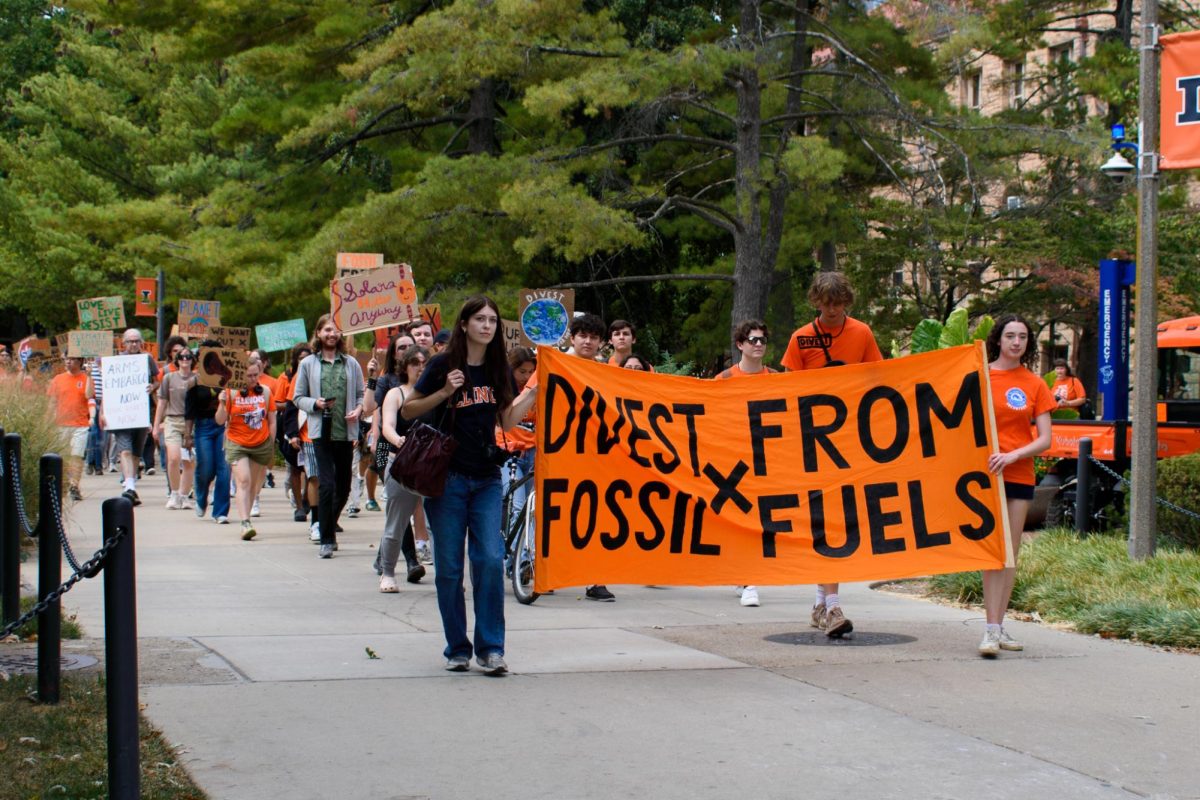
Fossil Free Illinois and several student organizations marched and chanted through the Main Quad Friday afternoon, demanding the University administration divest from fossil fuels.
Rally organizers said the UI System has over $170 million invested in the fossil fuel industry. Robin Kaler, the University’s associate chancellor for strategic communications and marketing, has disputed this figure, stating in February that the number is around $13 million.
Representatives from Students for Environmental Concerns, Graduate Employees’ Organization, Illini Democrats, Amnesty International, Students for Justice in Palestine and the Young Democratic Socialists of America joined and spoke at the rally.
A representative from Fossil Free Illinois, Grayson Hodson, junior in LAS and senior columnist for The Daily Illini, delivered a speech to attendees before the march began. Hodson criticized the University’s investments in both fossil fuels and weapons companies.
Get The Daily Illini in your inbox!
Hodson said actions from the community are essential to pressure the University to divest.
“The arc of the moral universe is long, but it bends towards justice,” Hodson said in his speech, quoting Martin Luther King Jr. “But it won’t bend without change. We are the pressure necessary for change, change that will show us to be the moral victors of history.”
In a campus-wide student referendum from the spring, 72.94% of student voters, or 3,178 voters, were in favor of University divestment from the fossil fuels industry. Hodson suggested this outcome was evidence of the student body’s opposition to these investments.
The 2020 Illinois Climate Action Plan set an objective to fully divest from fossil fuel companies by fiscal year 2025. Fossil Free Illinois leaders say that this commitment is a key reason they expect the University to act now.
University officials, however, said investment decisions are made through the UI System and the University of Illinois Foundation, not by the University.
In an email to The DI, Patrick Wade, the University’s director of executive communications and issues management, said the upcoming 2025 iCAP will refine its focus toward actions the campus can directly control, such as cutting emissions, improving efficiency and advancing carbon-neutral research.
“Our commitment remains to act where we can have the greatest and most immediate impact,” Wade wrote. “Students remain an important part of this process through discussions on sustainable investments and transparency.”
The University, in a statement on its website, argued that divestment is unlikely to produce meaningful change.
“By divesting, the investor seeking change loses any influence over the company’s direction, making it less likely that behavior will shift as intended,” the website read.
Starting at Alma Mater, the protestors marched south on Wright Street between Green and John, chanting phrases like, “We will not rest until we divest!” and, “What do we want? Climate justice! When do we want it? Now!”
En route to the Main Quad, protestors passed by the Henry Administration Building and called on University administrators to engage with their calls for divestment. They then zig-zagged through the diagonal Main Quad sidewalks before stopping just north of Foellinger Auditorium.
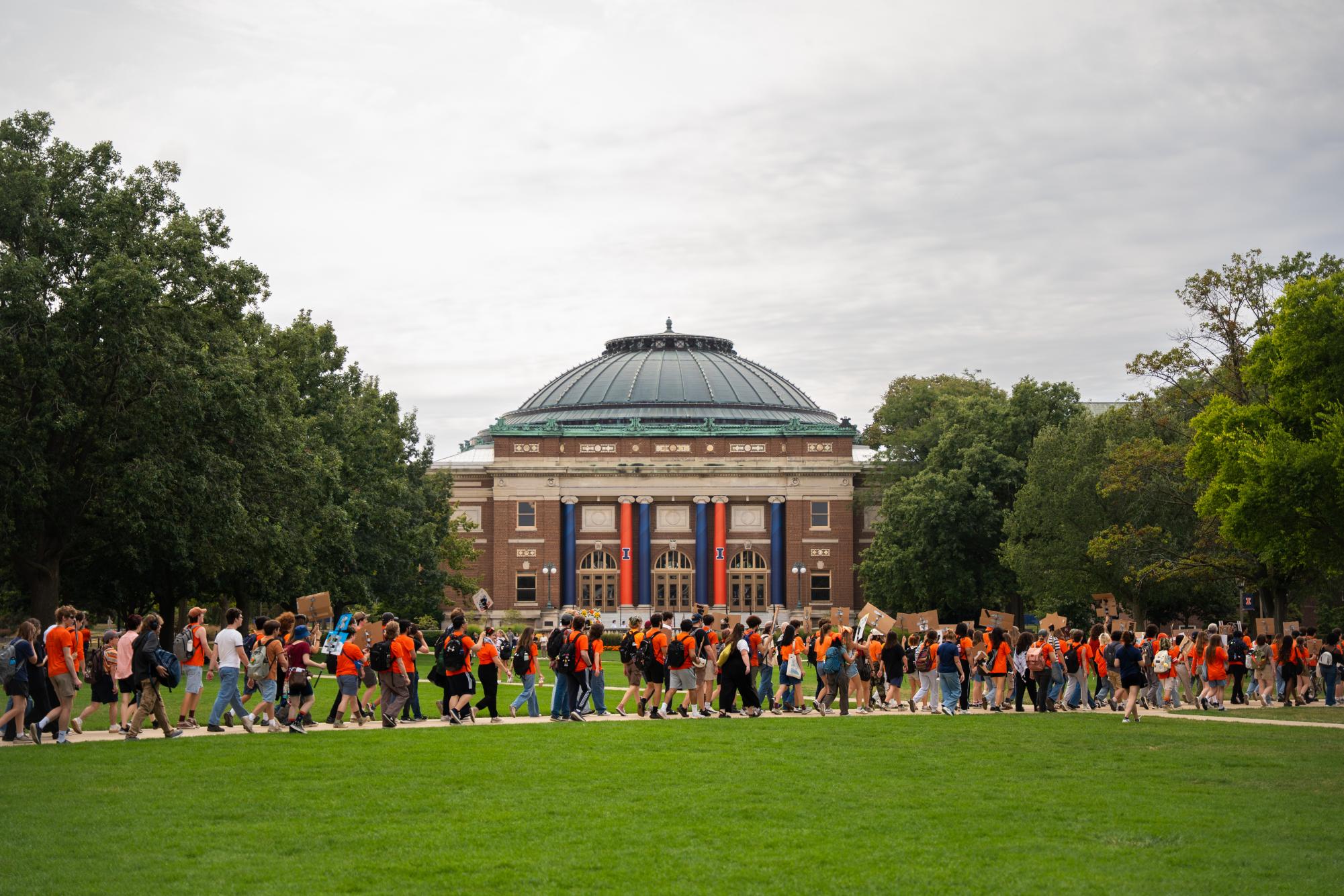
Gabi DalSanto, a junior in ACES, student body president and vice president of SECS, gave a speech to attendees in front of Foellinger Auditorium. DalSanto said she takes issue with her tuition money funding fossil fuel-related projects like oil pipelines.
“We should have a say in the companies that our tuition money is getting invested in,” DalSanto said to The DI in an interview. “I’m an environmental science major … If I’m here to learn how to protect the environment, but in doing that, I’m funding these big oil projects, that’s not at all what I want to be doing.”
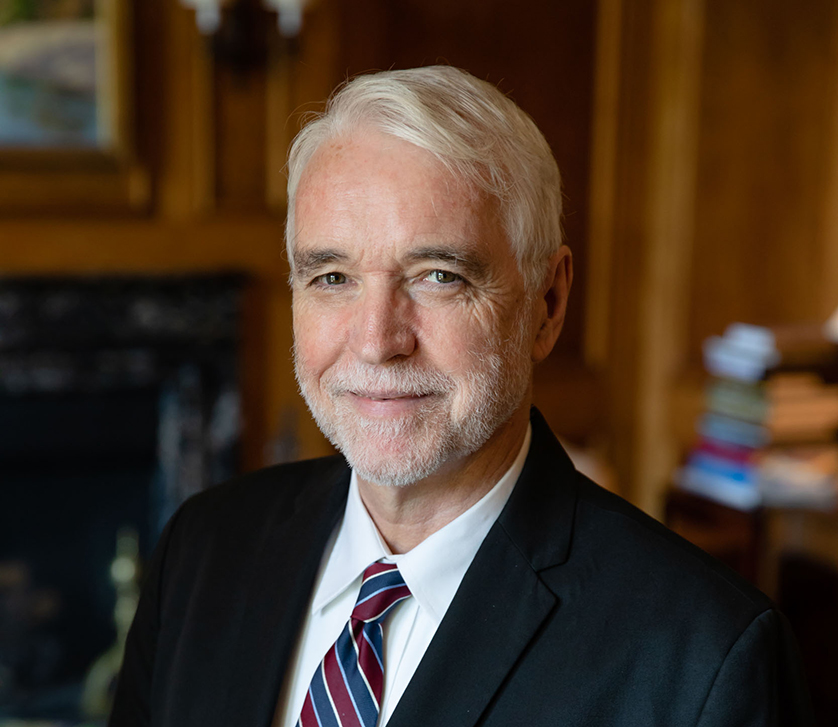
According to DalSanto, students should email University administrators like Chancellor Charles Isbell Jr. and UI System President Tim Killeen and call on them to divest.
Another speaker, Matthew Hurtado, sophomore in LAS and representative of YDSA, said he was not okay with the University investing in fossil fuels.
“It’s ethically not okay to know that the money that my parents and I are working so hard for is going directly into harming our environment,” Hurtado told The DI in an interview.
A representative from SJP, who did not share their name, criticized what they called a “suppressive approach” to governing the school. They cited the termination of SJP’s status as a RSO in September 2024.
The SJP representative then read excerpts from an open letter they sent to Chancellor Charles Isbell Jr. on Sept. 12. The letter called on Isbell and the University administration to divest from companies supplying weapons or technology to Israel and to not suppress student expression.
After the speeches, attendees dispersed from the Main Quad.
“When students are here making their voices heard, creating a big disruption like we are today, administrators are forced to take a look at the policies that they’ve implemented and hopefully make change,” DalSanto said.