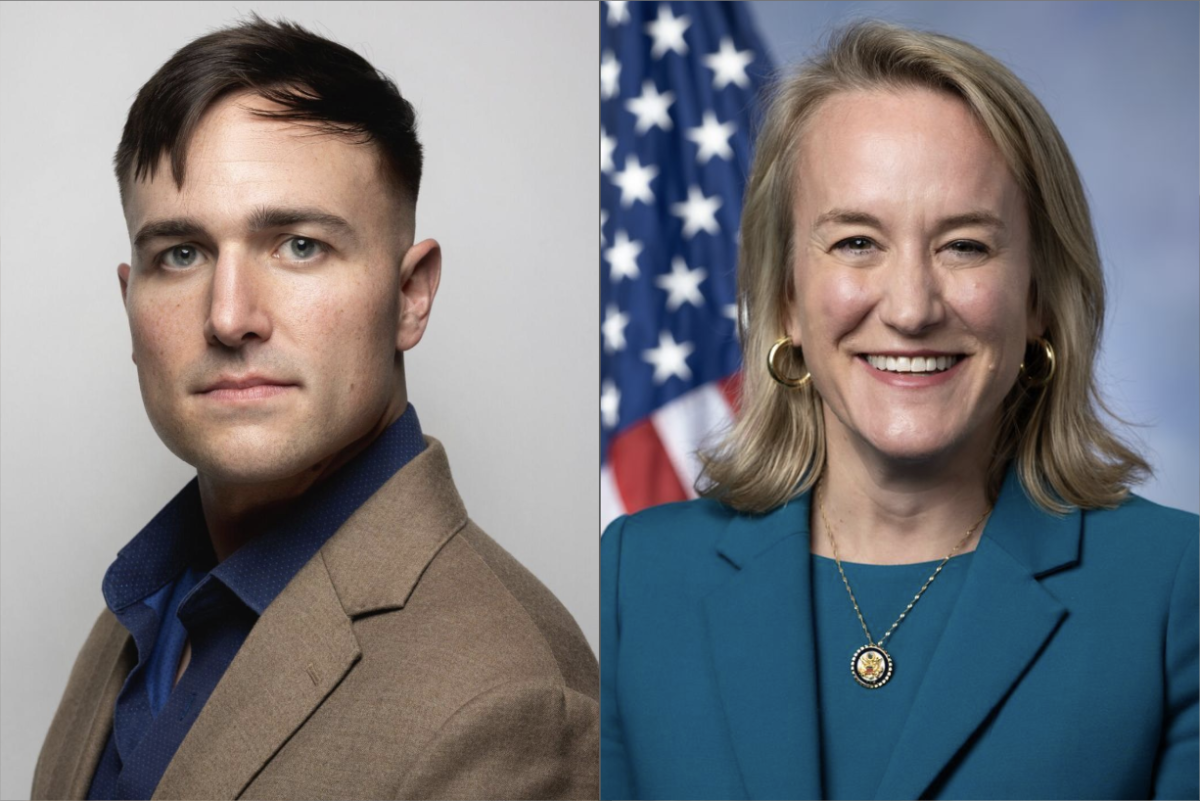
Republican candidate for Illinois governor Ted Dabrowski has a long history with Illinois. After his time in the Illinois Policy Institute think tank and as president of the data-driven economy and government research website Wirepoints, he has become confident that his research and knowledge can be used to make Illinois a “top-five state” in the nation.

Polls from recent months have Dabrowski at around an 8% share of Republican voters, with former Illinois State Senator Darren Bailey as the favorite. If Dabrowski wins the primary, he would still have to face Gov. JB Pritzker in the Nov. 3 general election.
Dabrowski visited the University and posted an Instagram reel on Feb. 7 explaining changes he’d make to the University as governor. The video has received over 186,000 views since it was posted.
“Right now I’m in Champaign at the University of Illinois campus, and one of the big issues here is that there are 6,000 Chinese foreign nationals at the school, when there used to be only 37 back in 2000,” Dabrowski said in the post. “And the big problem with that is that they’re taking up spots for kids from Illinois.”
Dabrowski also said in the video that he would cap tuition and the number of foreign nationals that can attend flagship schools in the state.
Get The Daily Illini in your inbox!
The Daily Illini spoke with Dabrowski on Feb. 23 to discuss all things higher education and at the University: international students, DEI, rising tuition and more. This interview has been edited for length and clarity.
The DI: What made you want to run for governor of Illinois?
Dabrowski: Well, for the last 15 years I’ve been working to … expose the problems, promote solutions. We should be a top-five state in this country. We should be one of the best states. We’re smack in the middle of the country. We’ve got the best infrastructure, right? We’ve got the land. We’ve got the lake. We’ve got these universities — you’re at one of them. We should be competing with Texas or with Florida and all these other states that are doing really well for people, for jobs, for investment. And we’re not. And the last 15 years, I’ve been fighting for a better Illinois. I’ve watched us continue to go down, down, down. We’re losing people, we’re losing great businesses. And I couldn’t stand to be on the sidelines anymore. I said I’ve been working on the solutions, let me fight to go implement them. So I’m running for governor.
The DI: I saw an Instagram post about you coming to the University, and in it, you gave a series of statements about the University, its student body and ways you would change it if you were elected governor. I selected a few claims from that video, and I’m going to ask you about each of them. Does that sound okay?
Dabrowski: Yeah, absolutely.
The DI: First, you mentioned changes in the amount of “Chinese foreign nationals” at the school. You said there were 37 Chinese international students in the year 2000, and over 6,000 today. Where did you initially hear those numbers from, and what was your gut reaction to them?
Dabrowski: Steve Cortes did a documentary of sorts on this issue. Of course it’s an issue that’s been covered quite a bit by others. … It struck me. I was in Champaign. I said, ‘My gosh, you know, this we need to expose.’ I meet many parents who talk about how they can’t get their kids into Champaign anymore. I’m a son of immigrants, so I’m a huge immigrant supporter. But I’m also … I like closed borders. I like controlled immigration, legal immigration. You know, with a plan. My mom came from Ecuador, my father came from Poland. They both came legally, they became citizens. But I’m very appreciative of being … a first-generation American and son of immigrants, I care about that a lot. But at the same time, what I learned was that U of I is a land-grant institution. It’s meant to protect … to give educational opportunities to those who are from here, who may not have the means to go to the more expensive schools. And so we should make sure that we take care of Illinoisans first. So that was kind of the motivation behind it. And of course the foreign nationals are a big share of what’s happening at U of I.
The DI: For the record, I’d like to note that I went ahead and I checked the numbers with Daniel Mann, who’s the University’s associate provost for enrollment management. He told me that the 37 students in the year 2000 only included undergraduates, while there are 6,231 students today including undergraduates, graduates and professional students. So in 2000, the total number of Chinese international students was actually 688, not 37. Does that change how you view this situation at all?
Dabrowski: No. So 37 you’re saying was only undergraduates?
The DI: Yes.
Dabrowski: Right. Well no, it doesn’t. I mean obviously numbers matter and — if you know my work at Wirepoints, I’m pretty picky about getting those data points right. Right, so that only includes undergraduates. And graduate — we could have a different discussion about undergraduate and graduate. Not that that diminishes the whole discussion. But 600 to 6,000 it’s still — the point is, we could talk about the numbers, but the point is this. And since I’ve put that piece out I’ve had lots of parents come up to me and tell me their own kids who did extremely well in school could not get into U of I and end up going out of state. And again, those are anecdotes, but I think the feel is there that we should protect our children first.
The DI: Is the thing that really bothers you the percent change? The fact that it’s gone tenfold in total amount of internationals? Or the number as compared to in-state? So for example, I calculated the difference between the number of students that were in-state in the year 2000 and the number of students that were international in 2000, and how much that’s gone up. For example, since 2000 to today, there are 5,100 more in-state students and 5,500 more students from China than there were in the year 2000. So kind of a similar sort of number there.
Dabrowski: I’ve been looking at this for a while — not at the foreign nationals — I’ve been looking at just the number of kids that stay in Illinois for higher ed and the cost of higher ed and the bloat of higher ed. So this is a much bigger discussion. My feelings to talk about this come from this: we are losing huge amounts of our youth. If you look at the recent data, and I published this in Wirepoints and I’m happy to do it from memory — we’re the number one loser, or have the biggest reduction in the number of 18-year-olds and under in the country. Now, we’re the number three loser of people to other states in the country, Illinois is. We have a massive out-migration problem. And you can see that in all kinds of ways. We’re one of just three states to shrink in population between 2010 and 2020. It was West Virginia, Mississippi, those are — I think most people consider those troubled states in some way. And Illinois is the third. How the heck we’re a shrinking state is phenomenal given who we are. And then you see states like Texas and Florida, Tennessee and Carolina booming and growing. That’s where I am struggling here. It’s why I’m running. We can’t keep bleeding people. We can’t keep bleeding companies.
So I did the research on the increasing cost of higher ed, and it keeps going up. And we’ve lost control of that. The New York Times and others have done lots of studies about our loss of students to other states. We’re a loser in terms of people, and our youth to other states for higher ed. … It’s been a while since I’ve looked at the precise numbers, so forgive me for my lack of precision on the numbers. But, we’re losing. And so when I saw that … the administrative boom in higher ed is phenomenal, crazy. The pay that we’re — the pensions that we’re paying to higher ed is crazy. We’re pricing ourselves out of the market.
So we have a big higher ed problem, so that’s why I jumped on this. Because not only is it a higher ed problem, now we’re bringing in foreign nationals, who pay the full fare, most of them pay the full cost. We’re using them to fund the mess we’ve created. For me, it’s all a debacle. And we really need to look at what’s happening at U of I. Which is also why I mentioned in my reel, we need to put a cap on tuition so that our kids can afford it. It’s a big mess. And I wish, you know, in today’s world I did a short reel, right? Whatever it was, 30 seconds. I don’t like to record that way because the problem is much bigger and it deserves more attention. But it’s too expensive, we’ve got massive bureaucratic bloat, these pensions are crazy, and we’re losing our kids. All that needs to be solved. It’s why I’m running for governor. It’s one of the big reasons I’m running for governor.
The DI: When you say that you’ll put a cap on tuition to make the schools affordable again, what price would you cap tuition at?
Dabrowski: I would love to be able to tell you I have a number. It would not be fair for me to throw out a number. It needs to be looked at, I need to analyze it. I need to be fair to the system. … But I can tell you this: it needs to be capped so that it doesn’t keep growing out of control. And I take a little bit of a lead from a guy like Mitch Daniels in Indiana who capped Purdue — I think it’s been capped for 10 years if I have it right? Now, to do that, you really have to get a control of your cost. You have to understand where your bloat is. If I were to talk right now about the pensions that are paid and the salaries that are paid at the University.
And look, it’s one thing to pay well for the teachers or the professors in the classroom. It’s another for the administrative bloat. You’ve got a bunch of DEI stuff going on at the University as well. We need to get control of that. … You’ve got a whole DEI infrastructure getting paid a lot of money. That stuff needs to be unwound as well. We don’t need DEI in our classrooms, we need focus on academic excellence. And that’s again what I’m after. I know I’m covering a lot of issues, but that’s the reality for our universities, especially for U of I.
The DI: So I’m going to assume that when it comes to the same thing about capping the number of foreign national students that you mentioned, there’s no exact number for that either?
Dabrowski: I don’t have an exact number. Like you said, you’ve got to kind of roll back the numbers and all that. It should be a small number. I can imagine that there are a lot of people who would love to send their kids to U of I. If you look at the reel we put out, that’s been the most popular reel that I’ve ever done, ever. I couldn’t believe how much attention it garnered. And you’ll see how many parents come on there to say ‘What the heck.’ You see a lot of people who are proud of the U of I, alumni who would like to see, you know, get rid of the DEI, get back to the academic excellence, make sure that it’s affordable, make sure that our kids can get in. So it’s a big issue.
The DI: In May of 2025, the vice provost for budget and resource planning said the following: “If the international students were replaced with resident tuition, it would be a loss of $115 million.” If a cap were put on foreign national students, what, if anything, would you do to supplement the lost tuition revenue at universities affected by the change?
Dabrowski: Well, it’s funny. I mean, I could take it to the other extreme, right? Why don’t we just have a public university for Asian students to pay full fare and we can fund other things with it, right? I mean, I’m being sarcastic, but the goal of a land-grant institution is to take care of Illinoisans, not to take care of Chinese. Now that said, I mentioned earlier all that spending and all that administrative bloat we’ve gotten. This is why the U of I does it. They need money to fund the bloat. They need money to fund all that administrative stuff that goes on that doesn’t belong there. Or, if they want to have it, it should be done at a much lower cost. But when you start bringing in the Chinese nationals who pay full fare, that’s subsidizing what I would call … the bloat in the administrative mess. … I don’t like what they’re saying, because they’re saying we need that money to fund our DEI programs and all the other things that don’t belong there. And I will encourage you — if you don’t mind — Google Wirepoints Ted Dabrowski administrative university cost. I think you’ll find some of this stuff out there. You’re seeing pensions at $500,000, $400,000. And salaries that are outrageous. And I get it. I get it. This is a high-end university, but we have to find a balance between that and affordability for our everyday Illinoisans.
The DI: When we talk about a land-grant, as the University is, is that something that gives it an extra special designation besides being a public school to you? In terms of who they should have let in and how the school should kind of be run?
Dabrowski: Yeah, and again, this is something I’m not an expert in. I haven’t done big research on it. But the land-grant institution, they were meant to take care of the locals. You know, engineering, farming, things like that. Again, it’s why we pay taxes, to fund these institutions, right? And of course it’s supplemented by people’s tuitions. But when we get to the point where one, we become too expensive. We know the stories of all these kids going to Alabama and Georgia, and it’s amazing how many of our Illinois kids go there. And they’re not coming home, by the way. This is the other problem. Once they go out there, they find other places, like in Austin or like that … Tennessee, they’re all staying there. So this is why we’re — part of our population loss. So one when it’s too expensive and when the positions are blocked by foreign nationals it’s something to be discussed and debated strongly.
The DI: Tell me about DEI, your thoughts, in terms of universities. Is this something you’ve seen a lot of? Something you consider some big problem, or something you would replace entirely or adapt to in some way?
Dabrowski: It’s a massive problem. We’re seeing this in all our schools, K-12. We’ve got it in the universities. We’ve got it in companies. It’s this whole victim and oppressor type mentality. You know, you can’t win unless you are — look, I just believe in the individual. I believe in propping up any individual. You can be the best you can be with a great education, especially at a U of I or any of our schools, if you can think about — we’re going to push literacy like crazy and that’s something I’m obsessed about. Our kids aren’t learning how to read in our schools anymore, you can see that from the state data. So many of our schools are no longer achieving literacy for kids.
So we need to think about literacy, numeracy and excellence, rather than, oh ‘You’re the victim,’ ‘You’re the oppressor.’ It’s a whole backwards way of thinking about things, everything racially. Any kid can succeed. I don’t care about what color you are, where you’re from. But if you don’t have that mentality, if you have the victim mentality, then our children aren’t taught to think that they can win, that they can succeed. And I’m a son of immigrants, and that’s how my parents taught me. We were bright, young Ecuadorian mom, Polish dad, they both came here with nothing, and you figure out how to battle it out and make things happen.
The DI: Changing subjects, I saw a headline last week that you’re suing the Champaign County clerk. Am I correct in saying that?
Dabrowski: That’s correct. Yeah, we’ve sued. Yeah.
The DI: Can I ask what that was about?
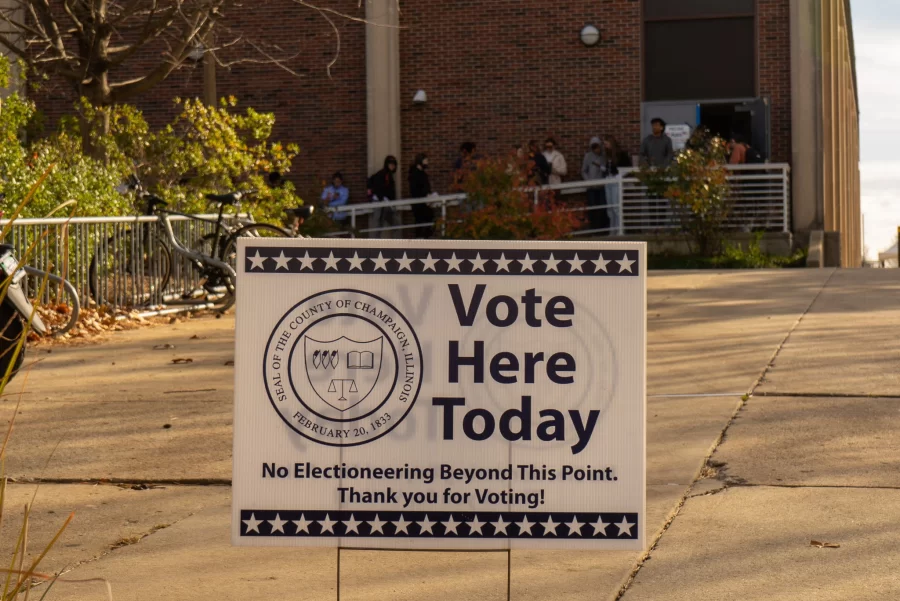
Dabrowski: Well yes. So my campaign for governor, Ted for Illinois is my name. So Ted is the name that you’ll see marketed like crazy, and that’s how people will, I hope, remember when they see us on the ballot. We’re the first name on the ballot. … But Champaign misspelled my name, and they put Tad, T-A-D. Not a huge change, but if you’re glancing and seeing for names you might recognize, there’s a difference. And so we reached out to the Champaign County Clerk Aaron Ammons and asked him to fix the ballots. And initially they said they wouldn’t reprint. I’ve yet to get back (inaudible) that they’ve done that, I have to check in today. But it’s key. One hundred one counties got my name right, Champaign County got it wrong. You’ve got to have uniformity in ballots if you want voter integrity and voter trust.
The DI: How much impact do you think that the misspelling and the broader issues that you described are really going to have on the overall election?
Dabrowski: I don’t know. In the end, we’ll have to see how close it is. But it matters. You can imagine that if it was not JB Pritzker but CB Pritzker, they would have fixed it in a minute. It’s hard for me to say, but what I do know is that as a candidate, I’m bothered by it because now I don’t trust it.
The DI: I believe that’s all of our time. Just about, right? I appreciate you taking the time to do this out of your busy schedule.
Dabrowski: Thank you. Well listen, March 17 is the primary. One, you need to be registered to vote. So make sure, I don’t care what party you vote for, go get registered. Number two is get to know the issues. Go to tedforillinois.com. I want to say that if you want the same that’s been going on in Illinois — maybe younger students may not know — but Illinois is not in a good path. We’re in the wrong path. We’ve been on the wrong path for a while. I offer that change. March 17, you’ve got to ask for a Republican ballot. But vote for me, and I will work with you all to make this state one of the top five states in the nation.